
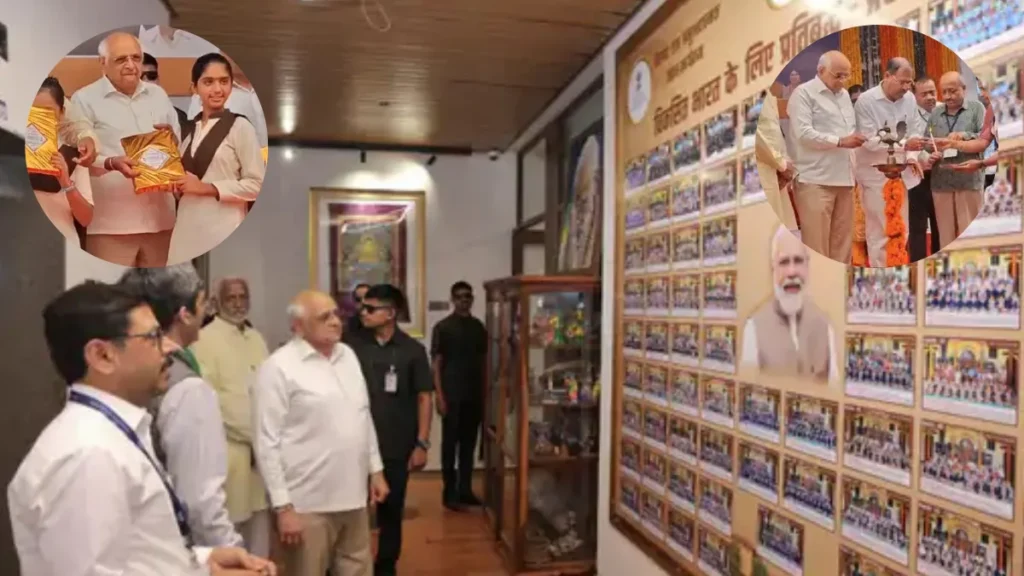
Vadnagar Becomes Focal Point of Gujarat’s Statewide School Enrollment Campaign
CM Launches School Admissions In Vadnagar as Gujarat officially began the 24th edition of its annual school enrollment campaign, marking another chapter in one of the state’s longest-running education initiatives. The three-day statewide programme was inaugurated by Chief Minister Bhupendra Patel from Vadnagar, the hometown of Prime Minister Narendra Modi and the place where he completed his early schooling.
The launch carries both symbolic and practical significance. Vadnagar’s historic B.N. High School, associated with the Prime Minister’s formative years, served as the starting point for a campaign that aims to bring millions of children into the formal education system across Gujarat.
The initiative, popularly known as Kanya Kelavani and Shala Praveshotsav, was originally launched in 2003 during Narendra Modi’s tenure as Chief Minister of Gujarat. Over the years, it has evolved into a large-scale educational outreach programme designed to improve enrollment, reduce dropout rates, and strengthen public participation in school education.
This year’s campaign is expected to facilitate admissions for approximately 2.858 million children across nearly 38,400 schools throughout the state.
A Statewide Mission to Strengthen School Education
The annual school enrollment programme has become a key component of Gujarat’s educational policy. Beyond simply admitting children into schools, the initiative focuses on increasing awareness about education, encouraging parental participation, and ensuring that no eligible child is left out of the schooling system.
As part of the campaign, ministers, government officials, local representatives, school management committees, teachers, parents, and community members are visiting educational institutions across Gujarat.
These visits are intended to assess school infrastructure, evaluate educational outcomes, review student attendance, and identify areas requiring improvement. Officials are also interacting directly with families to encourage continued education, particularly for girls and students from economically weaker sections.
The government believes that community participation has played a significant role in improving educational indicators over the past two decades.
Hundreds of Students Admitted During Launch Event
At the inaugural ceremony in Vadnagar, Chief Minister Bhupendra Patel personally welcomed and enrolled hundreds of students entering different stages of the education system.
The admissions covered children from Anganwadi centres as well as students entering Balvatika, primary grades, secondary education, and higher secondary classes.
According to officials, a total of 389 students were admitted during the launch programme.
The event featured interactions with students, teachers, parents, and local residents, highlighting the importance of education in shaping future generations.
Government representatives emphasized that enrollment campaigns are not merely ceremonial occasions but part of a broader effort to ensure continuity in education and prevent students from dropping out.
Why Vadnagar Holds Special Importance
The choice of Vadnagar as the venue for the launch drew considerable attention because of its historical and political significance.
Located in Gujarat’s Mehsana district, Vadnagar is known for its rich cultural heritage, archaeological importance, and association with Prime Minister Narendra Modi.
The town has witnessed extensive heritage conservation and development projects in recent years, transforming it into an emerging cultural destination.
For many participants, beginning the enrollment campaign from the school where the Prime Minister once studied carried a message about the transformative power of education.
State leaders repeatedly highlighted how educational opportunities can enable individuals from ordinary backgrounds to achieve extraordinary success.
Overview of the 2026 School Enrollment Campaign
| Key Details | Information |
|---|---|
| Programme Name | Kanya Kelavani and Shala Praveshotsav |
| Edition | 24th |
| Launch Location | B.N. High School, Vadnagar |
| Chief Guest | Chief Minister Bhupendra Patel |
| Duration | Three Days |
| Schools Covered | Approximately 38,400 |
| Expected Admissions | Around 2.858 Million Children |
| Focus Areas | Enrollment, Retention, Girls’ Education, Community Participation |
Chief Minister Reviews Vadnagar Music Museum Project
Alongside the education programme, Chief Minister Bhupendra Patel also reviewed progress on one of Vadnagar’s most ambitious cultural projects—a state-of-the-art music museum currently under development.
Officials briefed the Chief Minister on construction progress, exhibition planning, visitor experiences, and technological features that will be incorporated into the museum.
The project is being developed under the guidance of Gujarat’s Directorate of Museums and is envisioned as a major institution dedicated to preserving and promoting India’s diverse musical traditions.
Authorities believe the museum will become an important destination for scholars, musicians, researchers, students, and tourists from around the world.
A Tribute to Legendary Sisters Tana and Riri
The museum is dedicated to the memory of Tana and Riri, two legendary folk singers associated with Vadnagar.
Their story occupies a special place in Gujarat’s cultural history and continues to inspire musicians and cultural enthusiasts.
Museum planners have incorporated exhibits that explore their lives, contributions to music, and enduring legacy.
Officials say the project seeks not only to preserve history but also to introduce younger generations to India’s rich musical heritage through immersive and interactive experiences.
Exploring Thousands of Years of Indian Music
One of the museum’s defining features will be its attempt to present the evolution of Indian music from ancient times to the modern era.
Visitors will be guided through various phases of musical development, including traditional, devotional, folk, classical, and contemporary forms.
The museum is expected to showcase how music has evolved alongside India’s social, cultural, and spiritual traditions.
By combining historical narratives with modern technology, planners hope to create an experience that appeals to both casual visitors and serious researchers.
Eight Thematic Galleries to Offer Unique Experiences
The upcoming museum will feature eight specialized galleries, each focusing on a different dimension of music.
These galleries are designed to provide visitors with a deeper understanding of how music influences human life, culture, spirituality, and society.
Primitive Music Gallery
This section will explore sounds associated with early human civilizations and the origins of musical expression.
Nature Music Gallery
Visitors will experience sounds inspired by natural elements such as rain, wind, rivers, and birds.
Folk Music Gallery
Traditional instruments, songs, and cultural practices from different regions of India will be showcased.
Devotional Music Gallery
This gallery will focus on bhajans, Sufi traditions, and spiritual music forms that have shaped Indian society.
People’s Music Gallery
The role of music in social movements and collective expression will be highlighted here.
Raga Music Gallery
Indian classical music and the science behind ragas will form the centerpiece of this section.
Confluence Music Gallery
Visitors will learn how cultural interactions and exchanges gave rise to new musical traditions.
Heritage and Legacy Spaces
Additional sections will connect visitors to the broader story of India’s musical journey and its continuing influence.
Advanced Technology to Transform Visitor Experience
Museum officials say cutting-edge technology will play a central role in shaping visitor engagement.
Features planned for the facility include:
- 360-degree immersive projection experiences
- Interactive digital installations
- Advanced audio-visual presentations
- Experiential storytelling spaces
- Digital archives and research resources
The objective is to move beyond conventional museum displays and create an environment where visitors can experience music rather than simply observe artifacts.
Facilities for Researchers and Music Enthusiasts
The museum complex will also include dedicated facilities for learning and research.
Among the planned amenities are:
- Music library
- Research resources
- Recording studio
- Educational activity spaces
- Interactive learning centres
Officials believe these facilities will help establish Vadnagar as an important hub for music education and cultural scholarship.
Vadnagar’s Emerging Cultural Identity
The music museum forms part of a broader effort to strengthen Vadnagar’s identity as a cultural destination.
Over the past several years, heritage restoration projects, tourism infrastructure improvements, and cultural initiatives have contributed to the town’s transformation.
Authorities expect the museum to attract domestic and international visitors while generating opportunities for cultural tourism.
Experts note that projects combining heritage preservation with modern visitor experiences are increasingly important for promoting local history and identity.
Chief Minister Visits Prerna Sankul
Following the school enrollment programme, Chief Minister Bhupendra Patel visited Prerna Sankul, another major educational initiative in Vadnagar.
The Chief Minister toured the campus, interacted with students, and reviewed various educational and creative activities being conducted at the institution.
Officials provided detailed information about the centre’s academic approach, learning methodologies, and student development programmes.
The visit highlighted Gujarat’s broader efforts to integrate values-based education with modern learning systems.
A Historic School Reimagined for the Future
Prerna Sankul has been developed through the restoration and redevelopment of the historic primary school where Prime Minister Narendra Modi received his early education.
Originally established in 1888, the institution has been revitalized with support from the Archaeological Survey of India and other stakeholders.
The project combines heritage conservation with contemporary educational infrastructure.
Authorities describe it as an effort to inspire students by connecting them with stories of perseverance, leadership, and national development.
Education Based on Core Life Values
A distinctive feature of Prerna Sankul is its educational framework centered on nine key life values.
The programme is designed to encourage personal growth, ethical decision-making, leadership development, and civic responsibility.
Students and teachers from districts across India participate in learning experiences at the centre, creating opportunities for cultural exchange and collaboration.
Officials say the initiative aligns with broader efforts to prepare young people for both academic success and responsible citizenship.
Admission Guidelines for Students
During the enrollment campaign, admissions are being conducted according to age-based eligibility criteria established by education authorities.
Children aged above five years and below six years are being admitted to Balvatika programmes, while those aged above six years and below seven years are entering Class 1.
Admissions are also being facilitated for students progressing to secondary and higher secondary education after successfully completing their previous grades.
Education officials emphasized that ensuring smooth transitions between educational stages remains a priority.
Bhupendra Patel Highlights Education’s Transformative Power
Addressing the gathering at B.N. High School, Chief Minister Bhupendra Patel spoke about the role of education in creating opportunities and changing lives.
Referring to Prime Minister Narendra Modi’s journey, Patel said that determination, hard work, and education can enable individuals from ordinary backgrounds to reach positions of national leadership.
He noted that educational opportunities have expanded significantly over the past two decades and credited sustained efforts by teachers, parents, and government institutions for driving positive change.
The Chief Minister encouraged students to remain focused on learning and to make the most of available opportunities.
Gujarat’s Dropout Rate Shows Significant Improvement
One of the key points highlighted during the event was the substantial reduction in school dropout rates.
According to state officials, Gujarat’s dropout ratio has fallen dramatically compared with earlier decades.
The Chief Minister stated that dropout rates that once stood at around 37 percent have now declined to below one percent.
He also pointed to efforts undertaken by schools and teachers to identify absent students and reconnect them with education.
At B.N. High School itself, several students who had previously left school were reportedly re-enrolled through targeted outreach efforts.
Continued Focus on Girls’ Education
Government representatives reiterated the importance of ensuring equal educational opportunities for girls.
Officials highlighted initiatives designed to encourage female enrollment, improve retention rates, and support continued education through higher levels of schooling.
The state government believes that greater participation of girls in education contributes directly to social development, economic growth, and community well-being.
Several programmes have been introduced with the aim of supporting girls throughout their educational journey.
Addressing Digital Distractions Among Children
During his speech, Bhupendra Patel also spoke about the growing influence of television, smartphones, and digital devices on children’s daily lives.
He urged students to use technology responsibly and encouraged parents to establish healthy routines regarding screen time.
The Chief Minister emphasized the importance of balancing digital engagement with studies, physical activities, and social interaction.
His remarks reflected a broader concern among educators about maintaining student focus in an increasingly digital environment.
Education, Heritage, and Culture Converge in Vadnagar
The launch of the statewide enrollment campaign, the review of the music museum project, and the visit to Prerna Sankul together showcased a broader vision for Vadnagar’s future.
The town is increasingly being positioned as a place where education, heritage preservation, cultural enrichment, and community development intersect.
Through initiatives focused on school enrollment, educational innovation, and cultural conservation, Gujarat aims to create opportunities that benefit both current and future generations.
As the three-day campaign continues across thousands of schools, officials hope the programme will further strengthen enrollment rates, encourage lifelong learning, and reinforce the role of education as a foundation for social progress.
The CM Launches School Admissions In Vadnagar programme represents not only the beginning of a new academic journey for millions of children but also a reaffirmation of Gujarat’s long-term commitment to education, cultural heritage, and inclusive development.