
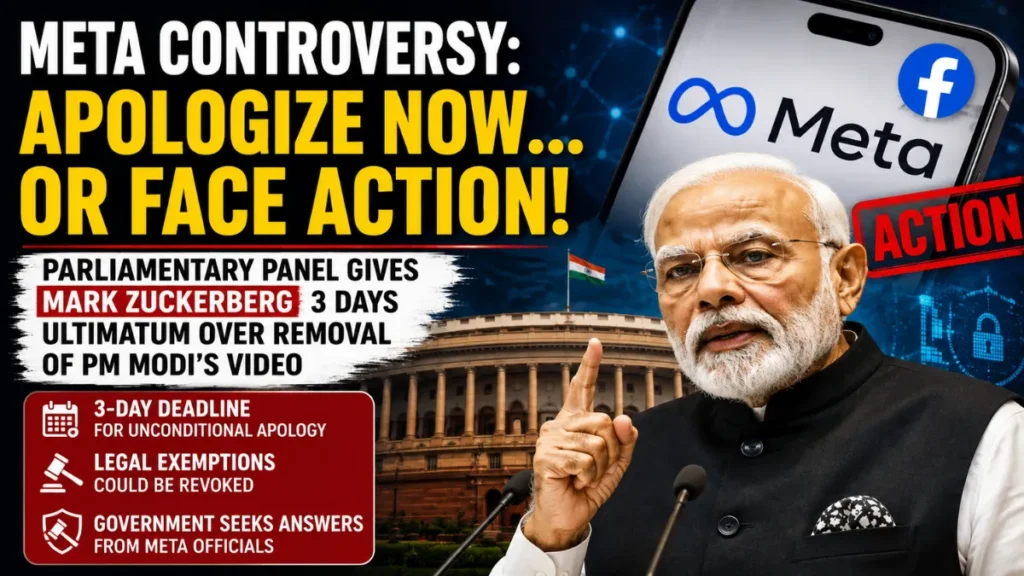
Meta Controversy has intensified in India after a parliamentary committee reportedly directed Meta CEO Mark Zuckerberg to issue an unconditional apology within three days over the temporary removal of Prime Minister Narendra Modi’s video from Facebook. According to officials, failure to comply within the given timeframe could lead to a review of the legal protections available to the company under Indian law.
The issue has also prompted discussions between India’s Ministry of Electronics and Information Technology (MeitY) and senior Meta officials. A two-day meeting began on August 5, with the government seeking explanations over the incident and the company’s content moderation practices.
The controversy has reignited a broader debate about algorithmic transparency, platform accountability, and how global technology companies moderate political content in one of their largest markets.
Why Has the Meta Controversy Escalated?
The latest Meta Controversy began after a video shared by Prime Minister Narendra Modi on July 23, 2026, was briefly removed from Facebook before being restored.
The video addressed the issue of examination paper leaks in India. During his message, the Prime Minister described paper leaks as a serious challenge affecting millions of students and promised stricter action, including the establishment of fast-track courts to speed up legal proceedings against those responsible.
After the video disappeared from Facebook, Meta restored it later, explaining that the removal had occurred due to a technical error. However, the explanation did not satisfy Indian authorities, leading to further scrutiny.
Parliamentary Committee Demands Unconditional Apology
Members of the Parliamentary Standing Committee on Information Technology questioned Meta representatives regarding the company’s content moderation system and alleged algorithmic bias.
Lawmakers reportedly raised several concerns, including:
- Alleged bias in Meta’s content moderation algorithms.
- Removal of legitimate public content while objectionable material remains available.
- Availability of explicit and harmful content on Meta platforms.
- Lack of transparency in moderation decisions.
Following the discussions, the committee reportedly asked Mark Zuckerberg to issue an unconditional public apology within three days.
According to committee members, if the company fails to respond satisfactorily, the government may consider reviewing Meta’s legal protections available under Section 79(3) of India’s Information Technology Act, which provides certain safe-harbor protections to online intermediaries when they comply with legal obligations.
Any decision regarding those protections would ultimately follow the legal process under applicable Indian law.
Why the IT Ministry Called Meta Officials
Apart from the parliamentary committee’s review, the Ministry of Electronics and Information Technology has also sought explanations from Meta.
Officials are expected to examine several issues during the meetings, including:
- Whether Meta is fully complying with Indian digital laws.
- Why safeguards designed for high-profile or verified accounts allegedly failed.
- The effectiveness of Meta’s internal content review systems.
- WhatsApp’s username policy.
- Instagram’s handling of Child Sexual Abuse Material (CSAM).
- Measures taken to prevent similar incidents in the future.
The government reportedly invited members of Meta’s global team to participate in the discussions in New Delhi.
What Happened to PM Modi’s Video?
On July 23, Prime Minister Narendra Modi shared a video on Facebook and Instagram addressing the nation’s youth.
In the video, he discussed the issue of examination paper leaks and emphasized the government’s commitment to taking strict legal action against those involved.
Soon after publication, the video became unavailable on Facebook.
Meta later restored the content and stated that its removal resulted from a technical issue rather than an intentional moderation decision.
Although the company apologized for the mistake, Indian officials described the explanation as inadequate and requested additional clarification.
Government Wants Stronger Answers
IT Secretary S. Krishnan reportedly stated that a company of Meta’s global scale is expected to maintain reliable technological safeguards.
According to government officials, the discussions aim to determine:
- Whether Meta fully understands Indian legal requirements.
- How its automated moderation systems operate.
- Whether adequate safeguards exist to prevent similar incidents.
- How the company plans to improve accountability.
Officials are also expected to review whether current compliance systems meet India’s regulatory expectations.
FIR Filed in Separate AI-Generated Content Case
The broader Meta Controversy also includes a separate legal development.
According to reports, Hyderabad Cyber Crime Police registered an FIR involving allegedly AI-generated and morphed content targeting Prime Minister Narendra Modi.
The complaint reportedly names Meta India head Arun Srinivas along with certain Facebook and Instagram accounts in connection with the investigation.
Authorities are expected to examine the circumstances under existing legal procedures.
What Type of Content Does Meta Normally Remove?
Meta’s Community Standards generally allow the company to remove or restrict content that violates its platform rules.
Categories typically include:
- Content promoting violence or inciting violent acts.
- Hate speech targeting protected groups.
- Terrorist or extremist propaganda.
- Child sexual exploitation or abuse material.
- Harassment, bullying, or threats.
- Copyright-infringing content.
- Harmful misinformation under applicable policies.
- Content violating local laws.
In some situations, content removed by automated systems may be restored after additional review if it is found not to violate company policies.
More Than Just One Video Under Review
Government officials have indicated that the August 5-6 meetings are not limited to the Prime Minister’s video.
The discussions are also expected to include:
- WhatsApp’s updated username policy.
- Previous government notices related to Instagram and CSAM.
- Meta’s broader compliance with Indian regulations.
- Platform accountability for AI-generated and manipulated content.
- Future safeguards for verified and public-interest accounts.
Officials are expected to seek detailed responses on each of these issues.
Possible Impact on Meta in India
If regulators conclude that Meta’s explanations are insufficient, the company could face increased regulatory oversight.
Possible outcomes may include:
- Stricter enforcement of content moderation rules.
- Greater transparency requirements for algorithmic decisions.
- Enhanced compliance obligations for large technology companies.
- Stronger oversight regarding AI-generated and manipulated content.
- Additional safeguards for verified public accounts.
Any regulatory measures would be subject to India’s legal and policy framework.
How Could Indian Users Be Affected?
India remains Meta’s largest market, with hundreds of millions of users across its platforms.
Industry estimates suggest that India has:
- More than 600 million WhatsApp users.
- Approximately 480 million Instagram users.
- Around 400 million Facebook users.
Because of this massive user base, any policy or regulatory change involving Meta has the potential to affect millions of individuals, businesses, creators, and organizations.
Potential impacts could include:
- Increased scrutiny of how social media companies remove content.
- More transparent appeal systems for wrongly removed posts.
- Stronger accountability for moderation decisions.
- Enhanced protections for user content and data.
- Stricter compliance requirements for international technology companies operating in India.
PM Modi’s Message on Paper Leaks
In the video shared on July 23, Prime Minister Narendra Modi described examination paper leaks as a major concern affecting students and their families.
He stated that authorities had already taken action against those allegedly involved and emphasized that protecting students’ academic futures remained a priority.
The Prime Minister also announced that fast-track courts would be established to ensure quicker legal action in such cases.
The remarks were made in the context of the broader discussion surrounding the NEET-UG examination paper leak issue.
Conclusion
The ongoing Meta Controversy has become more than a dispute over a temporarily removed video. It has evolved into a wider debate about platform accountability, automated moderation systems, AI-generated content, and the responsibilities of global technology companies operating in India.
With parliamentary scrutiny, government meetings, and ongoing legal proceedings unfolding simultaneously, the outcome could influence future digital governance, content moderation policies, and regulatory expectations for social media platforms in one of the world’s largest internet markets. As discussions continue, both regulators and Meta face increasing pressure to balance free expression, user safety, technological accuracy, and legal compliance.