
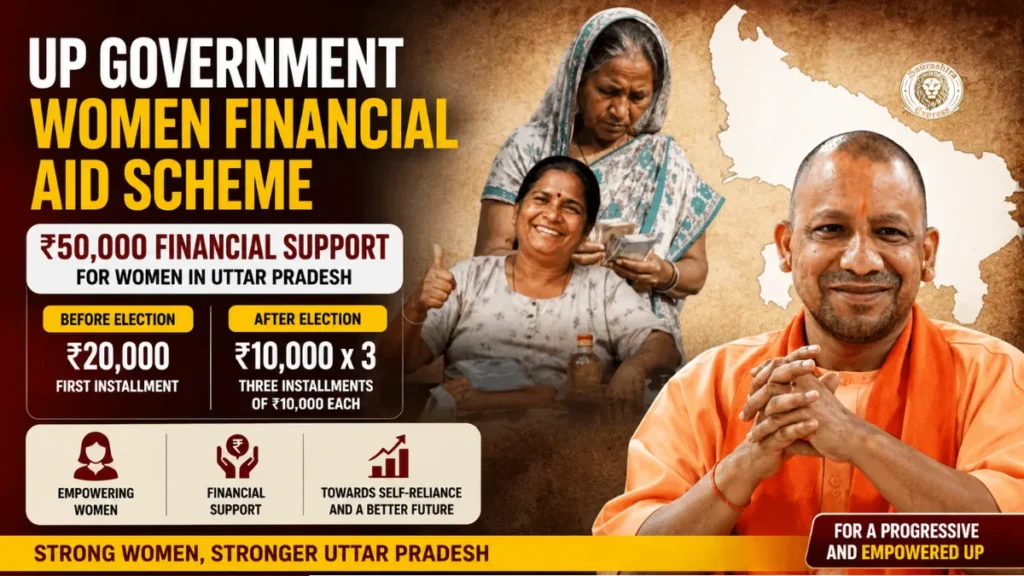
The proposed UP Government Women Financial Aid Scheme could become one of the major political and welfare initiatives ahead of the Uttar Pradesh Assembly Election 2027. According to the details emerging around the proposed plan, the Uttar Pradesh government is considering financial assistance of up to ₹50,000 for more than 50 lakh women.
Under the proposal currently being discussed, eligible women could receive an initial payment of ₹20,000 before the Assembly election. If the BJP returns to power after the election, the remaining assistance could reportedly be released in three installments of ₹10,000 each.
The proposal is still under discussion, and the final eligibility rules, payment schedule and implementation mechanism will depend on the government’s formal decision. The reported plan is being viewed in the wider context of increasing political attention toward women voters and women’s economic empowerment.
UP Government Women Financial Aid Scheme Could Provide ₹50,000
The proposed UP Government Women Financial Aid Scheme is expected to focus on financial assistance, self-employment and economic independence for women. The state’s Women and Child Welfare Department is reportedly preparing to put forward a proposal for consideration.
If approved, the scheme could provide a total financial benefit of ₹50,000 to eligible women. The reported structure would provide ₹20,000 before the Assembly election, followed by three payments of ₹10,000 each after the election if the BJP government returns to power.
The plan is being discussed at a time when political parties across several Indian states have increasingly focused on direct financial support for women. Monthly or annual cash-transfer programmes have become an important part of welfare politics, particularly among women from low-income households.
For Uttar Pradesh, the proposed assistance could have a much wider impact because of the state’s large population and the substantial number of women voters.
Why Women Are at the Centre of the UP Election Strategy
Women have emerged as an increasingly important voting group in Indian elections. Political parties have been paying greater attention to issues such as household income, employment, self-employment, financial security and direct welfare benefits.
The proposed Uttar Pradesh scheme comes against this backdrop.
The government is reportedly examining a programme that could provide financial support to women while also encouraging them to become financially independent. The idea is not being presented only as a cash-support measure. Self-employment and economic empowerment are also expected to be important elements of the proposal.
Uttar Pradesh is estimated to have around 5.67 crore women voters, making women one of the most influential voter groups in the state.
With the 2027 Assembly election approaching, any large-scale welfare programme aimed at women could therefore attract considerable political and public attention.
BPL and Economically Weaker Families Could Get Priority
According to the proposal being discussed, the government may give priority to women from economically weaker sections.
Women belonging to Scheduled Caste and Scheduled Tribe families, along with women from Below Poverty Line (BPL) households, could be among those considered for priority under the scheme.
The government may also consider women from economically weaker families whose annual household income is reportedly not more than ₹12 lakh.
However, these eligibility conditions should be treated as part of the reported proposal until the Uttar Pradesh government officially announces the final rules.
The final scheme could include additional conditions relating to income, family status, age, residence, bank account details or other eligibility requirements.
Why the Proposed Scheme Is Being Compared With Bihar
The proposed Uttar Pradesh initiative is being discussed in the context of the experience of Bihar, where financial assistance to women became a major election issue.
Before the Bihar Assembly election, the Nitish Kumar-led NDA government implemented the Chief Minister Women Employment Scheme, with the objective of connecting one woman from each family with self-employment.
Under the initiative, eligible women were provided an initial financial assistance of ₹10,000 before the election. The broader promise was that after the woman began an income-generating activity, the government would assess the progress and could provide additional assistance of up to ₹2 lakh to help expand the work.
According to the information provided, around 25 lakh women received ₹10,000 each, involving expenditure of approximately ₹500 crore.
The NDA subsequently won 202 Assembly seats in Bihar. Political observers and leaders attributed part of the alliance’s strong performance to the support received from women voters.
This experience has reportedly encouraged political strategists in other states to consider similar women-focused financial assistance programmes.
What Is the Jeevika Didi Model in Bihar?
The Bihar example is particularly relevant to discussions around women’s economic empowerment.
The basic idea behind the model was to provide women with an initial amount of money that could help them begin or strengthen a self-employment activity.
Instead of limiting assistance to immediate household spending, the programme focused on helping women become connected with income-generating activities.
This approach is significant because financial assistance can have a longer-term impact when it is used to start a small business, purchase equipment, invest in livestock, expand a home-based activity or support another form of self-employment.
The Bihar experience has consequently become a reference point in political discussions about women-centric welfare schemes.
The proposed Uttar Pradesh programme, however, would have its own eligibility conditions and implementation structure if it is formally approved.
BJP’s Focus on Women Voters
Political analysts cited in the discussion around the proposal believe that women voters can have a strong influence on voting patterns within families.
The argument is that when a woman directly receives financial assistance, the benefit is felt at the household level. A woman who receives government support may also influence the political preferences of other members of her family.
This is one reason why women’s welfare schemes have increasingly become a central feature of election strategies across India.
The BJP and NDA have already seen women-focused financial assistance programmes in several states. Similar initiatives have been implemented in Madhya Pradesh, Maharashtra, Odisha and other parts of the country, although the amount, eligibility criteria and payment structure vary from state to state.
The proposed UP Government Women Financial Aid Scheme would therefore fit into a broader national trend of governments using welfare programmes to support women’s financial security and participation in economic activities.
Women Cash Transfer Schemes Across Indian States
Several Indian states have introduced financial assistance programmes specifically targeted at women. The amounts and payment schedules differ from one state to another.
| State | Women-focused scheme | Reported assistance |
|---|---|---|
| Madhya Pradesh | Ladli Behna | ₹1,250 per month |
| Chhattisgarh | Mahtari Vandan | ₹1,000 per month |
| Jharkhand | Maiya Samman | ₹1,000 per month |
| Delhi | Mahila Samriddhi | ₹2,500 per month |
| West Bengal | Lakshmir Bhandar | ₹1,500–₹1,700 per month |
| Maharashtra | Majhi Ladki Bahin | ₹1,500 per month |
| Odisha | Subhadra Yojana | ₹10,000 annually in two installments |
| Tamil Nadu | Magalir Urimai Thogai | ₹1,000 per month |
| Karnataka | Gruha Lakshmi | ₹2,000 per month |
| Assam | Orunodoi | ₹1,250 per month |
| Himachal Pradesh | Indira Gandhi Pyari Behna | ₹1,500 per month |
| Telangana | Mahalakshmi | ₹2,500 per month |
| Andhra Pradesh | Aadabadi Nidhi | ₹1,500 |
| Punjab | Mai Dhiyan Satkar | ₹1,000–₹1,500 |
| Goa | Griha Aadhar | ₹1,500 |
These programmes show how women’s direct financial assistance has become an increasingly common feature of state-level welfare policies.
The proposed Uttar Pradesh scheme would be different because the reported plan involves a total benefit of ₹50,000 rather than a simple fixed monthly payment.
Mission 2027: Why Uttar Pradesh Is Important for the BJP
The Uttar Pradesh Assembly election expected in 2027 carries major political importance for the BJP.
After electoral victories in states including Haryana, Maharashtra, Delhi and Bihar, the party faces the challenge of maintaining its position in Uttar Pradesh, India’s most politically significant state.
The BJP’s performance in Uttar Pradesh changed substantially between the 2019 and 2024 Lok Sabha elections. In 2024, the party’s seat tally in the state fell from 64 seats to 34, while the Samajwadi Party made significant gains.
The Samajwadi Party’s PDA, referring broadly to its political outreach toward backward classes, Dalits and minorities, became an important part of its electoral strategy during the 2024 Lok Sabha election.
Following the Lok Sabha results, Chief Minister Yogi Adityanath reportedly acknowledged the scale of the challenge during a BJP legislative party meeting, with discussions around the party’s possible seat position if an Assembly election were held at that time.
This has increased the importance of rebuilding support among different voter groups ahead of the 2027 Assembly election.
Can a Women-Focused Scheme Counter the PDA Strategy?
Within BJP circles, a large financial assistance programme for women is being viewed as one possible way of broadening the party’s support base.
Women do not vote as a single bloc, and election results cannot be attributed to one welfare programme alone. However, political parties increasingly recognise that women-focused welfare can influence household-level economic decisions and voter perceptions.
The proposed scheme could therefore become part of a larger political strategy aimed at strengthening the BJP’s connection with women voters while also presenting the government as focused on economic empowerment.
The effectiveness of such a programme would ultimately depend on factors such as eligibility, timely payments, ease of registration, transparency, implementation and whether beneficiaries actually experience a meaningful improvement in their economic situation.
Uttar Pradesh Already Has a Large Women’s Self-Help Group Network
The state already has a significant network aimed at connecting women with self-employment.
Under the Uttar Pradesh State Rural Livelihood Mission, women are organised into self-help groups and encouraged to participate in income-generating activities.
The model generally brings women together in groups and provides them with access to financial assistance, training and opportunities to develop livelihoods.
According to the figures provided, around 98,76,389 women from 8,99,398 families are currently associated with these groups.
This existing network could potentially provide an important foundation for any new women-focused financial assistance programme.
If the proposed ₹50,000 assistance is linked with self-employment or livelihood activities, existing women’s groups could play a role in reaching beneficiaries and supporting them after the initial financial assistance is provided.
The Bigger Question: Cash Assistance or Long-Term Empowerment?
The proposed UP Government Women Financial Aid Scheme also raises a larger question about how governments should design women’s welfare programmes.
Direct cash assistance can provide immediate relief to families, especially when household expenses are rising. At the same time, programmes that connect women with employment, entrepreneurship and sustainable income can potentially provide longer-term benefits.
For this reason, the proposed plan’s emphasis on self-employment and economic independence could become particularly important.
If women receive financial assistance and are also provided with training, market access, credit support and guidance, the impact could extend beyond the immediate payment.
A successful programme would not only transfer money but could help women build a more stable source of income.
What Could Happen Next?
The scheme is reportedly still at the discussion and proposal stage. The Uttar Pradesh government would need to finalise the eligibility criteria, budget, application process, payment mechanism and other operational details before implementation.
The most important details women will eventually want to know include who qualifies, how applications will be submitted, what documents will be required, whether the benefit will be transferred directly into bank accounts and when the first payment will be made.
The reported proposal suggests that the first ₹20,000 could be provided before the Assembly election, with three subsequent ₹10,000 installments dependent on the BJP returning to government.
Until an official notification is issued, however, the proposed payment schedule and eligibility conditions should not be treated as final.
Why the ₹50,000 Proposal Could Become a Major Election Issue
The size of the proposed assistance makes the plan particularly significant.
A total benefit of ₹50,000 could be considerably larger than the monthly assistance offered under several existing women-focused schemes in other states. For low-income households, such an amount could help meet important expenses or provide initial capital for a small livelihood activity.
At the same time, the political timing of the proposal is likely to attract attention because the state is heading toward the 2027 Assembly election.
The central question will be whether the programme is ultimately implemented, who receives the money and how the government presents the initiative to voters.
For millions of women in Uttar Pradesh, the practical value of the scheme will depend less on political messaging and more on whether the promised assistance reaches eligible beneficiaries without delays or complicated procedures.
UP Government Women Financial Aid Scheme: What Women Should Know
At present, the reported proposal can be summarised around a few key points:
- The proposed scheme could provide a total financial benefit of ₹50,000 to eligible women.
- More than 50 lakh women could potentially be covered.
- The reported first installment could be ₹20,000 before the Assembly election.
- Three additional installments of ₹10,000 each could follow if the BJP returns to power.
- Women from BPL, SC, ST and economically weaker families could receive priority.
- Families with reported annual income of up to ₹12 lakh could potentially be considered.
- The scheme is expected to focus on women’s financial support, self-employment and economic independence.
- Final eligibility rules and implementation details have not yet been established through a formal announcement.
Conclusion
The proposed UP Government Women Financial Aid Scheme could become a major welfare and political initiative ahead of the Uttar Pradesh Assembly Election 2027. With a reported total assistance of ₹50,000 for more than 50 lakh women, the plan would represent a substantial financial commitment if approved.
The proposal comes at a time when women-focused welfare programmes have become increasingly important across Indian states. Experiences in Bihar, Madhya Pradesh and Maharashtra have strengthened the political focus on direct financial assistance for women, while Uttar Pradesh already has a large network of women involved in self-help groups and livelihood programmes.
For the Yogi Adityanath government, the proposed scheme could serve two purposes: providing financial support to women and strengthening the government’s outreach among a crucial voter group.
However, the proposal remains subject to the government’s final decision. Until an official notification is released, the reported amount, eligibility criteria and installment schedule should be considered proposed rather than confirmed.
The coming months will reveal whether the UP Government Women Financial Aid Scheme becomes a formally approved programme and whether it develops into one of the defining women-focused welfare initiatives ahead of the 2027 Uttar Pradesh Assembly election.