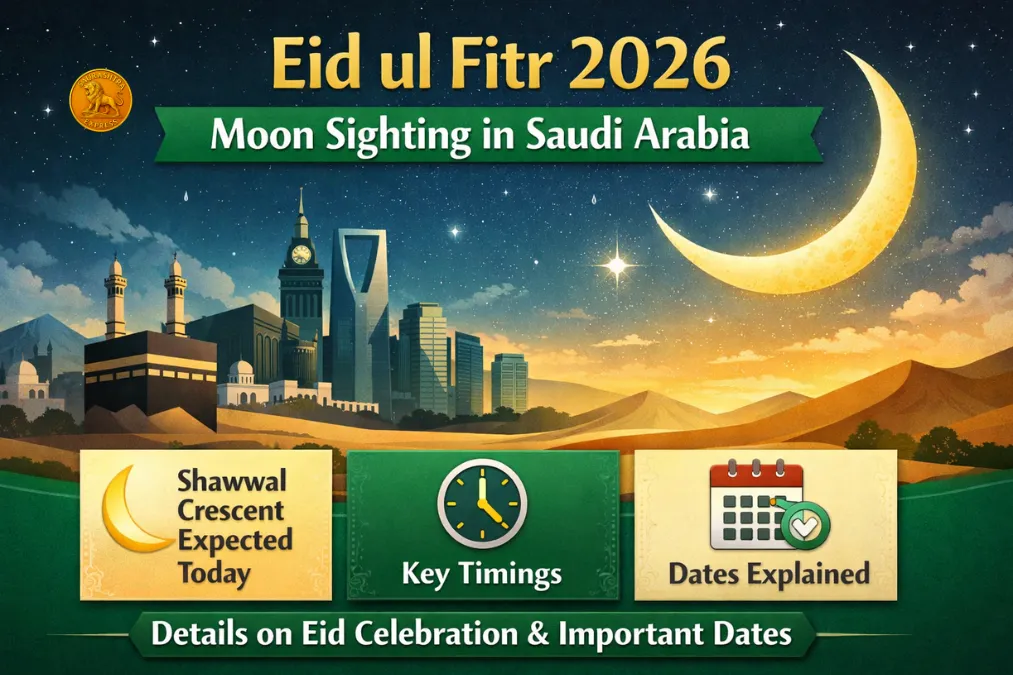
The much-awaited festival of eid ul fitr 2026 now depends on one crucial moment—the sighting of the Shawwal crescent moon in Saudi Arabia. As Muslims across the world prepare to conclude the holy month of Ramadan, all eyes are on the evening sky of Wednesday, March 18, when authorities have called for moon sighting.
The official announcement made after the observation will determine whether Eid will be celebrated on March 19 or the following day in various parts of the world.
Shawwal Crescent Moon Sighting Today in Saudi Arabia
According to an official statement issued by the Saudi Supreme Court, Muslims across Saudi Arabia have been urged to observe the sky for the Shawwal crescent moon on the evening of March 18, 2026.
Moon sighting is a deeply significant religious practice in Islam, as it marks the beginning of a new lunar month. In this case, the appearance of the crescent signals the end of Ramadan and the beginning of Shawwal, the month in which Eid ul-Fitr is celebrated.
Observers generally begin scanning the horizon immediately after sunset, as this is when the thin crescent becomes visible under clear sky conditions.
Eid Moon Sighting 2026 Saudi Arabia Timings
The visibility of the crescent moon is highly time-sensitive and depends on both astronomical positioning and local weather conditions. In Saudi Arabia, the expected window for moon sighting is brief but crucial.
Key Moon Sighting Details
| Event | Date | Time (Saudi Arabia) |
|---|---|---|
| Sunset Time | March 18, 2026 | 6:03 PM |
| Moon Sighting Window | March 18, 2026 | 6:03 PM – 6:40 PM |
| Expected Crescent Visibility | After Sunset | Within 20–40 minutes |
As shown above, the crescent moon is expected to appear shortly after sunset, with the best chance of visibility within a 20 to 40-minute window. However, visibility can vary depending on atmospheric clarity, geographical location, and cloud cover.
Once individuals report sightings, religious authorities review and verify these claims before making an official announcement later in the evening.
When Will Eid ul Fitr 2026 Be Celebrated?
The final date of eid ul fitr 2026 depends entirely on whether the crescent moon is sighted on March 18.
Possible Eid Dates
| Scenario | Eid Date in Saudi Arabia |
|---|---|
| Moon sighted on March 18 | March 19, 2026 (Thursday) |
| Moon not sighted (30-day Ramadan) | March 20, 2026 (Friday) |
If the crescent is successfully sighted, Eid celebrations will begin on Thursday, March 19, in Saudi Arabia and several Gulf countries. However, if the moon is not visible due to weather or other factors, Ramadan will complete 30 days, pushing Eid to Friday, March 20.
Impact on India and South Asia
The announcement in Saudi Arabia is closely followed worldwide, but countries in South Asia—including India, Pakistan, and Bangladesh—traditionally rely on their own moon sighting committees.
If Saudi Arabia confirms Eid on March 19, it is likely that South Asian countries will celebrate eid ul fitr 2026 on the next day, Friday, March 20.
Expected Timeline for South Asia
| Region | Likely Last Roza | Moon Sighting Night | Expected Eid Date |
|---|---|---|---|
| Saudi Arabia | March 18 | March 18 | March 19 |
| India | March 19 | March 19 | March 20 |
| Pakistan | March 19 | March 19 | March 20 |
| Bangladesh | March 19 | March 19 | March 20 |
In this scenario, Thursday, March 19, will be observed as the final day of fasting (Roza) in India and neighboring countries, with the moon sighting taking place that evening.
What Happens If the Moon Is Not Seen?
If the Shawwal crescent is not visible on March 18, either due to unfavorable weather or astronomical conditions, the Islamic calendar dictates that Ramadan will complete 30 days.
This means that fasting will continue for one more day, and Eid will be celebrated the day after.
This system is based on the Islamic lunar calendar, which relies entirely on the physical sighting of the moon rather than fixed dates. Each month begins only after confirmation of the new crescent.
Why Eid Dates Differ Across Countries
One of the unique aspects of eid ul fitr 2026 is that it may be celebrated on different days across the world. This variation often leads to confusion, but it is rooted in both science and tradition.
The visibility of the crescent moon depends on several factors, including:
- Geographic location
- Time of sunset
- Atmospheric conditions
- Moon’s angular distance from the sun
Because of these variables, the moon may be visible in one country but not in another on the same evening.
As a result, some countries begin Shawwal earlier, while others complete an extra day of Ramadan before celebrating Eid.
Significance of Eid ul Fitr
Eid ul-Fitr, also known as Meethi Eid or Ramzan Eid, marks the conclusion of Ramadan—the sacred month of fasting, prayer, and reflection for Muslims.
The festival is celebrated with great joy and devotion, beginning with a special morning prayer, followed by charitable giving (Zakat al-Fitr), family gatherings, and festive meals.
It is not just a celebration but also a moment of gratitude, spiritual renewal, and community bonding.
Read Also: Alvida Jumma Kab Hai 2026: Importance of the Last Friday of Ramadan in Islam
Conclusion:
As the evening of March 18 approaches, anticipation is building across the Muslim world. The sighting of the Shawwal crescent in Saudi Arabia will officially mark the end of Ramadan and the beginning of eid ul fitr 2026.
Whether Eid falls on March 19 or March 20, the festival remains a time of unity, faith, and celebration for millions around the globe.
Stay tuned for the official moon sighting announcement, which will confirm the exact date of Eid in your region.