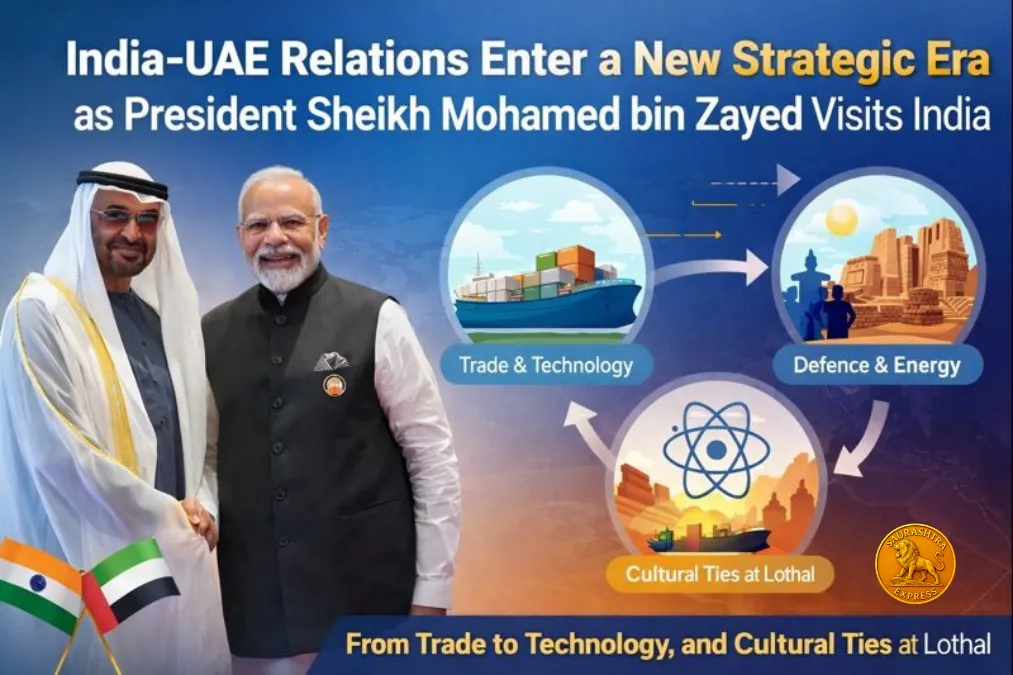
Lothal: India and the United Arab Emirates have taken another decisive step in strengthening one of the most dynamic partnerships in the global south, following the official visit of UAE President His Highness Sheikh Mohamed bin Zayed Al Nahyan to India. The high-profile visit, undertaken at the invitation of Prime Minister Narendra Modi, marked a significant milestone in the rapidly expanding India–UAE Comprehensive Strategic Partnership, reflecting a decade of growing trust, ambition and shared global outlook.
This was Sheikh Mohamed bin Zayed’s fifth visit to India in the last ten years and his third official visit as President of the UAE, underlining the depth and continuity of bilateral engagement between the two nations. The visit culminated in a wide-ranging joint statement that outlined cooperation across trade, investment, infrastructure, energy, defence, technology, space, education, culture and people-to-people ties — with the historic site of Lothal emerging as a symbolic anchor for the shared maritime and civilisational heritage of both countries.
A Partnership Strengthened Over a Decade
During their meetings in New Delhi, Prime Minister Modi and President Sheikh Mohamed bin Zayed conducted a comprehensive review of bilateral relations, reaffirming that the India–UAE Comprehensive Strategic Partnership has not only endured but deepened steadily over the past decade.
Both leaders noted that cooperation has expanded well beyond traditional diplomatic engagement, evolving into a multi-layered relationship encompassing economic integration, strategic coordination, innovation, defence collaboration and cultural exchange. They agreed that the partnership is increasingly future-oriented, rooted in mutual respect for sovereignty, strategic autonomy and shared regional and global responsibilities.
The leaders also welcomed recent high-level visits by the next generation of Emirati leadership, including Crown Prince of Abu Dhabi Sheikh Khaled bin Mohamed bin Zayed Al Nahyan and Crown Prince of Dubai Sheikh Hamdan bin Mohammed bin Rashid Al Maktoum, who also serves as UAE Deputy Prime Minister and Minister of Defence. These visits, they noted, symbolise generational continuity and long-term commitment to India–UAE relations.
Institutional Momentum and Strategic Dialogue
Prime Minister Modi and President Sheikh Mohamed bin Zayed endorsed the outcomes of key institutional mechanisms that have driven bilateral cooperation forward. These included the 13th High-Level Task Force on Investments, held in September 2025, and the 16th India–UAE Joint Commission Meeting along with the 5th Strategic Dialogue, convened in December 2025.
Both sides agreed that these frameworks have played a critical role in identifying new areas of cooperation, removing bottlenecks and aligning public and private sector priorities in both countries.
Trade Boom Under CEPA and a $200 Billion Vision
One of the most striking achievements highlighted during the visit was the dramatic expansion of bilateral trade following the signing of the Comprehensive Economic Partnership Agreement (CEPA) in 2022.
The leaders noted with satisfaction that India–UAE trade reached approximately USD 100 billion in FY 2024–25, a landmark figure that places the UAE among India’s top trading partners globally. Encouraged by this momentum and the strong enthusiasm of business communities in both countries, the two leaders set an ambitious new target: doubling bilateral trade to USD 200 billion by 2032.
To achieve this goal, both sides committed to deeper integration of supply chains, greater market access and targeted support for emerging sectors.
Empowering MSMEs Through Digital and Physical Corridors
Recognising the critical role of Micro, Small and Medium Enterprises (MSMEs) in job creation and economic resilience, the leaders directed their teams to accelerate efforts to connect MSMEs across India and the UAE.
They called for the swift implementation of flagship initiatives such as Bharat Mart, the Virtual Trade Corridor, and the Bharat-Africa Setu, which are designed to promote Indian MSME products across the Middle East, West Asia, Africa and Eurasia. These platforms aim to reduce trade friction, enhance digital connectivity and open new export markets for small businesses.
Investment Flows and the Dholera Vision
The leaders welcomed the strengthening of investment ties following the signing of the India–UAE Bilateral Investment Treaty in 2024, which has enhanced investor confidence and encouraged long-term capital flows across multiple sectors.
A key highlight of the discussions was the exploration of a potential UAE partnership in the development of the Special Investment Region (SIR) at Dholera in Gujarat. The proposed collaboration envisions the development of strategic infrastructure including:
- An international airport
- A pilot training school
- Maintenance, Repair and Overhaul (MRO) facilities
- A greenfield port
- A smart urban township
- Railway connectivity
- Integrated energy infrastructure
Prime Minister Modi also invited UAE sovereign wealth funds to participate in the second National Investment and Infrastructure Fund (NIIF) Infrastructure Fund, scheduled for launch in 2026, building on the success of the first fund.
Both leaders welcomed the establishment of DP World and First Abu Dhabi Bank (FAB) branches in GIFT City, reinforcing its rise as a global financial hub. FAB’s presence is expected to act as a bridge linking Indian corporates to GCC and MENA markets.
Food Security as a Strategic Priority
Food security featured prominently in the discussions, with both sides reaffirming their commitment to building resilient and sustainable supply chains. The leaders emphasised the importance of public-private partnerships, innovation and knowledge sharing to advance sustainable agriculture and strengthen national food resilience in line with their respective priorities.
Expanding Cooperation in Space and Advanced Technologies
India and the UAE agreed to deepen cooperation in the space sector, welcoming a new understanding to jointly advance commercialisation through cutting-edge space science and technology.
The proposed initiative aims to develop an integrated space ecosystem with end-to-end infrastructure, enabling joint India–UAE missions, expanding global commercial services, fostering high-skilled employment and supporting start-ups. The initiative also seeks to strengthen bilateral investment through sustainable business models.
Artificial Intelligence, Supercomputing and Digital Sovereignty
Science, technology and innovation emerged as another pillar of the partnership. The leaders agreed to strengthen cooperation in artificial intelligence (AI) and emerging technologies.
They welcomed the decision to collaborate on establishing a supercomputing cluster in India and to explore cooperation in setting up data centres. The leaders also directed their teams to examine the feasibility of creating “Digital Embassies” under mutually recognised sovereignty frameworks.
President Sheikh Mohamed bin Zayed expressed strong support for the AI Impact Summit, scheduled to be hosted in India in February 2026.
Energy Security and Nuclear Cooperation
The leaders expressed satisfaction with the strength of bilateral energy cooperation, underscoring the UAE’s vital role in India’s energy security.
They welcomed the signing of a 10-year LNG supply agreement between Hindustan Petroleum Corporation Limited (HPCL) and ADNOC Gas, under which India will receive 0.5 million tonnes of LNG annually starting in 2028.
The enactment of India’s Sustainable Harnessing and Advancement of Nuclear Energy for Transforming India (SHANTI) law was also welcomed, opening new avenues for civil nuclear cooperation. Both sides agreed to explore collaboration in advanced nuclear technologies, including large reactors, Small Modular Reactors (SMRs), nuclear safety and plant operations.
Financial Integration and Digital Payments
The leaders appreciated the deepening cooperation in the financial sector and directed their teams to work towards interlinking national payment platforms, enabling faster, cheaper and more efficient cross-border transactions.
Cultural Heritage and the Maritime Legacy of Lothal
In a powerful gesture of cultural diplomacy, Prime Minister Modi welcomed the UAE’s decision to provide artefacts for the National Maritime Heritage Complex at Lothal, one of India’s most significant archaeological sites.
Lothal, a key port city of the ancient Indus Valley Civilisation, symbolises India’s millennia-old maritime connections with the wider world, including West Asia. The inclusion of UAE artefacts at Lothal reflects shared seafaring traditions and reinforces cultural bonds that predate modern nation-states.
The leaders also agreed to establish a “House of India” in Abu Dhabi, envisioned as a lasting symbol of friendship, cultural exchange and people-to-people ties.
Education, Innovation and Knowledge Bridges
Education was identified as a cornerstone of the partnership. Building on the opening of offshore campuses of IIT Delhi and IIM Ahmedabad in the UAE, the leaders encouraged deeper collaboration between universities and educational institutions.
They also supported expanded student exchanges, cooperation in Innovation and Tinkering Labs, and the integration of India’s DigiLocker with UAE platforms to enable seamless verification of academic credentials — a move expected to enhance mobility, employment opportunities and ease of living.
Defence, Security and Counter-Terrorism Cooperation
The leaders reaffirmed their respect for sovereignty and territorial integrity and recognised defence and security cooperation as a core pillar of the Comprehensive Strategic Partnership.
They welcomed the momentum generated by recent exchanges between service chiefs and the successful conduct of bilateral military exercises. The signing of a Letter of Intent towards a Strategic Defence Partnership was also welcomed.
Both sides reiterated their zero-tolerance stance on terrorism, condemning it in all forms, including cross-border terrorism. They agreed to continue cooperation under the Financial Action Task Force (FATF) framework to combat terror financing and money laundering.
Regional Connectivity and Global Cooperation
The leaders recalled the launch of the India–Middle East–Europe Economic Corridor (IMEC) during the G20 Summit in Delhi in 2023 and reaffirmed its strategic importance.
They exchanged views on regional and global developments, highlighting strong coordination in multilateral forums. The UAE expressed full support for India’s BRICS Chairmanship in 2026, while India backed the 2026 UN Water Conference, to be co-hosted by the UAE.
Polar Science and Climate Collaboration
Both sides highlighted their growing collaboration in polar science, acknowledging positive outcomes from joint expeditions and institutional cooperation. They agreed to advance this partnership through targeted research initiatives and closer coordination between national polar institutions, contributing to evidence-based climate action.
A Visit That Reinforces a Global Partnership
President Sheikh Mohamed bin Zayed Al Nahyan concluded his visit by thanking Prime Minister Narendra Modi for the warm welcome and generous hospitality.
From ambitious trade targets and advanced technology collaboration to cultural initiatives centred around Lothal, the visit underscored the breadth and depth of the India–UAE relationship — a partnership that is increasingly shaping regional connectivity, global innovation and shared prosperity in the 21st century.