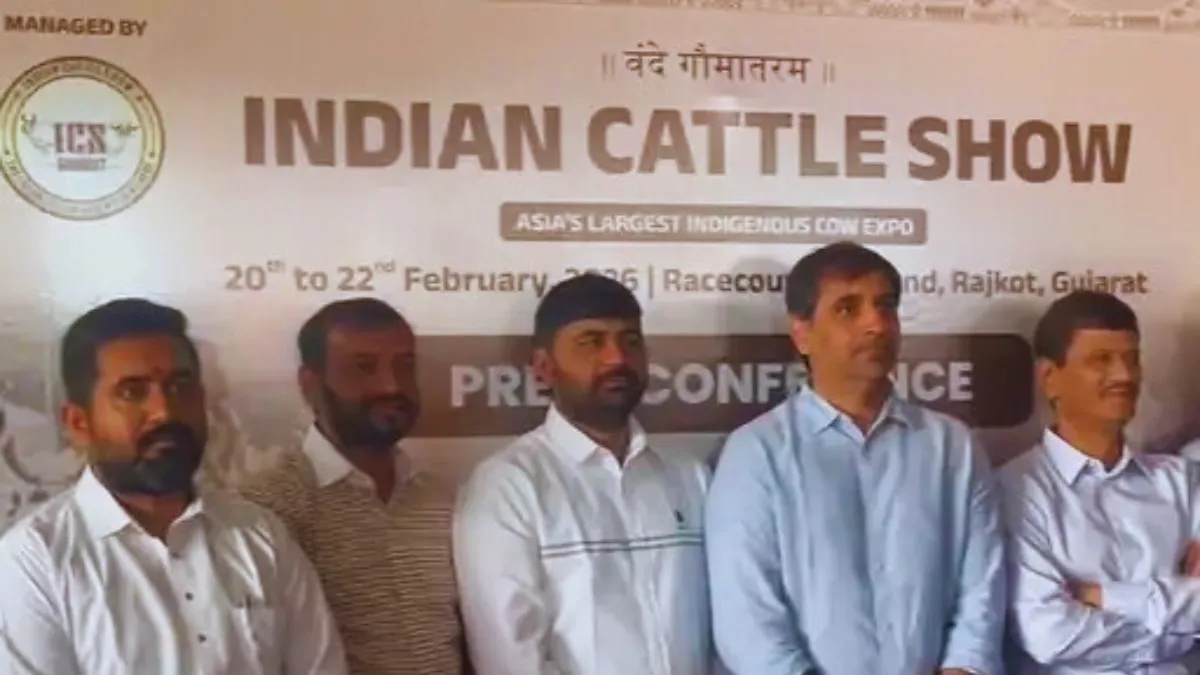
Rajkot is set to host a landmark agricultural and livestock event as the Indian Cattle Show, recognized as the largest of its kind in Asia, takes place from February 20 to 22 at the city’s iconic Racecourse Ground. The prestigious three-day exhibition and competition will be formally inaugurated by Gujarat Governor Acharya Devvrat, marking a historic moment for India’s indigenous cattle conservation movement.
Organized under the banner of the International Federation of Indigenous Zebu Cattle of India (IFIZCI), the Indian Cattle Show aims to spotlight the country’s prized native cow breeds while promoting sustainable agriculture and rural economic growth. The event comes at a time when global interest in indigenous livestock preservation and organic farming is rapidly increasing.
A First-of-Its-Kind Event in Independent India
While cattle fairs were once common before independence, organizers say this is the first time such a large-scale and internationally aligned Indigenous Cattle Show is being conducted in India post-independence. The initiative is inspired in part by Brazil’s long-standing cattle exhibitions, which have been held for nearly a century, as well as growing advocacy for cow-based rural development in India.
The Rajkot edition is being described as a transformative step toward strengthening India’s indigenous cattle economy. According to event coordinators, the show is being organized without any government financial assistance, yet it will distribute prize money of up to ₹50 lakh (approximately £48,000 / $60,000). The entire prize pool is intended to benefit farmers and cattle rearers directly, encouraging scientific breeding practices and high-quality livestock management.
200 Elite Indigenous Cows Selected from 8,000 Registrations
Interest in the Indian Cattle Show has been overwhelming. Nearly 8,000 indigenous cows were registered from across Gujarat, Maharashtra, and Rajasthan. After a rigorous screening process, 200 of the finest specimens have been selected to compete—100 Gir cows and 100 Kankrej cows, two of India’s most celebrated native breeds.
The Gir cattle breed, originally from Gujarat, is globally admired for its high milk yield and disease resistance. Similarly, the Kankrej cattle breed is known for strength, adaptability, and dual-purpose productivity (milk and draught power). These breeds represent the backbone of India’s indigenous cattle heritage.
The competition at the Indian Cattle Show will evaluate animals based on:
- Milk production capacity
- Physical fitness and structural strength
- Genetic traits and breeding potential
- Overall beauty and breed characteristics
Special emphasis will also be placed on breeding bulls (Nandi), including assessments of genetic quality, physical build, and future breeding suitability.
Five Key Competition Categories
The Indian Cattle Show will feature competitions across five major categories:
Cow Categories
- Best Milch Cow (Highest milk production)
- Best Cow (Beauty and breed standards)
- Best Two-Tooth Heifer (Young female with strong genetic promise)
Bull Categories
4. Best Nandi (Breeding Bull)
5. Best Two-Tooth Bull Calf
Experts will closely examine dental age, skeletal structure, body symmetry, udder development, stamina, and breed purity. Organizers emphasize that the evaluation process will be scientific and transparent, reflecting global livestock competition standards.
Promoting Indigenous Breeding and Natural Farming
The central theme of the Indian Cattle Show is not merely competition but conservation and rural empowerment. Organizers believe that indigenous cows play a crucial role in supporting natural and chemical-free agriculture. Cow-based farming practices—including the use of cow dung and urine in organic fertilizers and pesticides—have gained renewed attention in sustainable farming circles across the UK, US, and beyond.
According to members of the organizing committee, cows are considered one of the most important sources of nutrition and livelihood in Indian households. Beyond milk production, they contribute to soil health, biogas generation, and rural employment. The broader vision of the Indian Cattle Show is to develop a self-sustaining cattle economy where gaushalas (cow shelters) do not rely on donations but instead generate their own income through structured breeding and dairy initiatives.
Boosting Rural Economy and Self-Employment
A major objective of the Indian Cattle Show is to build a cow-based rural economic model. Organizers highlight four core pillars:
1. Cattle Conservation (Gau Sanvardhan)
Scientific preservation and improvement of Indian indigenous breeds.
2. Cow-Based Natural Agriculture (Gau Prakritik Krishi)
Encouraging organic, chemical-free farming methods centered on indigenous cattle.
3. Rural Development (Gau Gram Vikas)
Creating self-employment and small-scale industries through cattle-based enterprises.
4. Healthy Living (Gau Sanvardhak Parivar)
Promoting cow-derived products for improved health and sustainable lifestyles.
By linking livestock development with entrepreneurship, the Indian Cattle Show aims to empower farmers economically while preserving India’s genetic cattle heritage.
Prominent Dignitaries to Attend
In addition to Governor Acharya Devvrat, several political and spiritual leaders are expected to attend the grand event. Among the distinguished guests are:
- Shankar Chaudhary, Speaker of the Gujarat Legislative Assembly
- Harsh Sanghavi, Deputy Chief Minister of Gujarat
- Narendra Modi, whose broader advocacy of cow-based rural products has inspired similar initiatives nationwide
Several saints, spiritual leaders, and representatives from royal families of Bhavnagar, Gondal, Jasdan, and Bhadwa are also expected to grace the event, highlighting the cultural and historical importance of indigenous cattle in Indian society.
A Global Spotlight on Indigenous Breeds
The Indian Cattle Show is poised to place Rajkot on the global livestock map. With increasing international awareness about climate-resilient breeds, low-input dairy systems, and organic agriculture, indigenous Indian cattle are gaining attention among researchers and dairy experts worldwide.
By bringing together breeders, farmers, veterinarians, genetic experts, and policymakers under one roof, the event is expected to foster collaboration and knowledge exchange. Organizers believe that such initiatives could significantly enhance India’s dairy sector while safeguarding rare and valuable native breeds for future generations.
Also read: Mahant Swami Maharaj Birthday Celebration 2026: A Grand Spiritual Spectacle in Vadodara
A Historic Step Forward
As preparations reach their final stages, excitement is building among cattle breeders and agricultural communities. The Indian Cattle Show is not just an exhibition—it represents a larger movement toward sustainable agriculture, rural prosperity, and genetic conservation.
With 200 elite cows competing, ₹50 lakh in prize money at stake, and Asia’s largest platform dedicated to indigenous cattle, Rajkot’s Racecourse Ground is set to witness a defining moment in India’s livestock history.
For farmers, breeders, and advocates of organic agriculture, the Indian Cattle Show marks the beginning of a renewed commitment to preserving and celebrating India’s proud cattle heritage on a global stage.