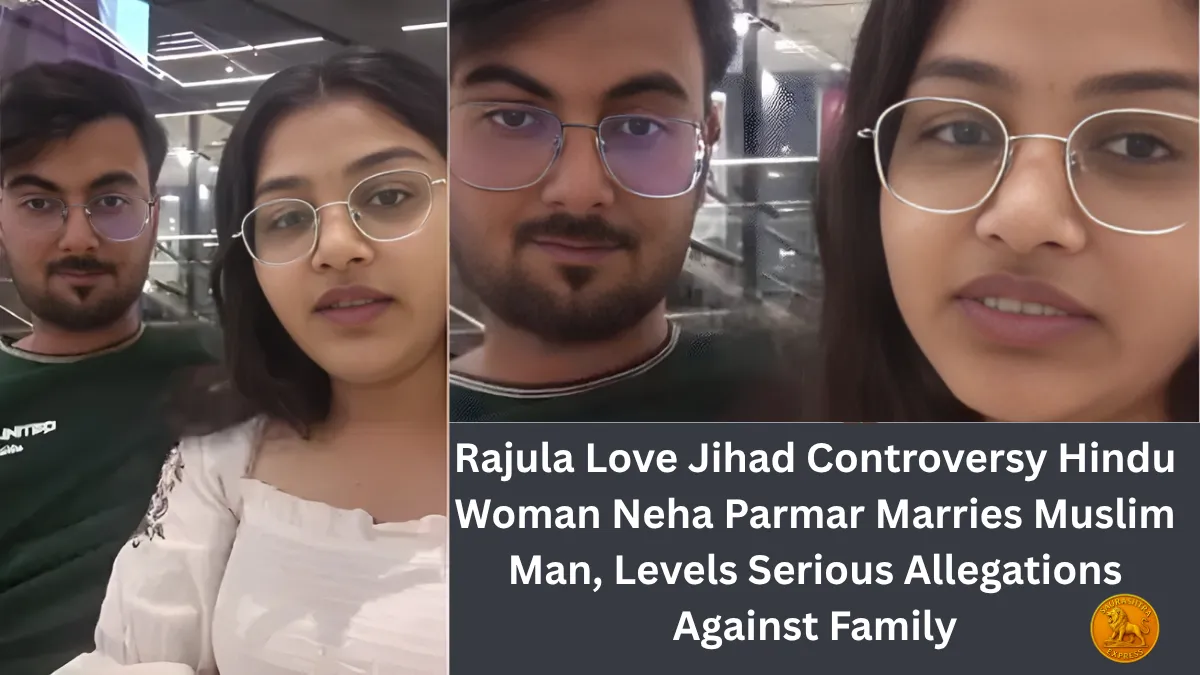
The Rajula Love Jihad Controversy has emerged as one of the most talked-about and sensitive issues in Gujarat in recent days, drawing widespread attention across the state and beyond. What began as a personal relationship between two individuals has now escalated into a larger social and political debate involving interfaith marriage, family disputes, and public protests.
At the center of the controversy is a young Hindu woman, Neha Parmar, from Rajula in the Amreli district, who has married a Muslim man, Muhis Firani. Their relationship and subsequent marriage have triggered strong reactions, particularly from certain Hindu organizations, which have labeled the case as an instance of “love jihad.” Meanwhile, the couple has publicly appealed for peace and the right to live their lives without interference.
Background: Rising Debate Over Interfaith Marriages in Gujarat
Over the past few years, Gujarat has witnessed an increasing number of discussions surrounding interfaith and intercaste marriages. Several high-profile cases involving public figures and ordinary citizens alike have fueled debates about personal freedom, cultural values, and societal acceptance.
The Rajula Love Jihad Controversy is being seen as part of this broader trend, where personal choices are increasingly becoming matters of public concern. While some view such marriages as a reflection of evolving social norms, others perceive them as a threat to traditional values, leading to sharp divisions in public opinion.
The Rajula Case: What Happened?
According to available information, Neha Parmar and Muhis Firani had been in a relationship for several years before deciding to get married. The couple reportedly tied the knot around four to five months ago, choosing to keep their marriage private initially.
The situation came into the spotlight after Neha’s family filed a police complaint, stating that she had left home about ten days earlier under the pretext of attending a beauty course in Surat and had not returned. As the matter gained attention, the couple released a video on social media confirming their marriage and sharing their side of the story.
This revelation quickly intensified the Rajula Love Jihad Controversy, with various groups stepping in and raising concerns.
Allegations by Family and Police Involvement
Neha’s parents approached the local police station, expressing concern over her sudden disappearance and claiming they were unaware of her whereabouts. The complaint led to increased scrutiny and involvement from authorities.
However, the narrative took a different turn after Neha publicly stated that her family had known about her relationship with Muhis for over a year. She alleged that despite this, her family had later denied any knowledge of the relationship after learning about the marriage.
The police are currently examining the situation, focusing on ensuring the safety of both individuals and maintaining law and order in the region.
Neha’s Allegations Against Her Family
In a video that has since gone viral, Neha Parmar made serious allegations against her own family. She claimed that after discovering her relationship with Muhis, her family confined her at home for several months.
According to Neha, she was not allowed to step outside, communicate freely, or make her own decisions. She also alleged that she faced both physical and mental harassment during this period.
Neha further stated that her family pressured her to marry another man against her will. Feeling suffocated and unable to exercise her freedom, she eventually left home under the pretext of going for work or training and chose to marry Muhis of her own accord.
Her statements have added a deeply emotional and personal dimension to the Rajula Love Jihad Controversy, highlighting the clash between individual choice and family expectations.
The Couple’s Public Appeal for Peace
As the controversy grew, Neha and Muhis released another video addressing the public. In their message, both emphasized that their marriage was based on mutual consent and that no coercion or pressure was involved.
Neha clearly stated that she is happy with her decision and considers the matter to be purely personal. She urged people not to interfere in their private life and appealed to society to allow them to live peacefully.
Muhis Firani also echoed her sentiments, folding his hands in a gesture of respect and requesting everyone not to politicize or communalize their relationship. He stressed that Neha had taken the decision independently and was not influenced or forced in any way.
Their appeal reflects a desire to move beyond the controversy and focus on building their life together, away from public scrutiny.
Reaction from Hindu Organizations
The Rajula Love Jihad Controversy has sparked strong reactions from several Hindu organizations, including groups like the Vishva Hindu Parishad (VHP) and Bajrang Dal. These organizations have alleged that the marriage is a case of “love jihad,” a term often used in certain narratives to describe interfaith relationships involving alleged religious conversion.
Protests have been organized in the region, with demonstrators expressing anger and demanding action. The issue has quickly escalated from a personal matter to a broader socio-political debate.
These reactions have further intensified the situation, leading to increased tension in the area.
Threat Allegations and Safety Concerns
In their statements, Neha also claimed that both she and Muhis, along with his family, have received threats following the controversy. She expressed concern for their safety and stated that if anything were to happen to them, her family should be held responsible.
Such claims underline the seriousness of the Rajula Love Jihad Controversy, as it now involves not only social tensions but also concerns about personal security.
Authorities are expected to take these allegations seriously and ensure that appropriate measures are in place to protect all parties involved.
A Personal Choice or a Political Issue?
One of the most striking aspects of the Rajula Love Jihad Controversy is how a personal relationship has evolved into a politically charged issue. Neha herself has stated that her marriage is a matter of personal choice and happiness, not something that should be debated publicly.
However, the involvement of organizations and the scale of protests suggest that the issue has taken on a larger symbolic significance. It has become a focal point for discussions about religion, identity, and individual rights.
This raises important questions about where society should draw the line between personal freedom and collective sentiment.
Social Media’s Role in Amplifying the Issue
Social media has played a crucial role in bringing the Rajula Love Jihad Controversy into the public eye. The couple’s videos have been widely shared, allowing people across the country to hear their perspective directly.
At the same time, social media has also amplified reactions, with opinions pouring in from all sides. While some users have expressed support for the couple’s right to choose, others have criticized the marriage and echoed concerns raised by protesting groups.
This digital amplification has contributed to the rapid spread and escalation of the controversy.
Legal and Social Dimensions
From a legal standpoint, adults in India have the right to marry a person of their choice, regardless of religion, provided they comply with applicable laws such as the Special Marriage Act.
The Rajula Love Jihad Controversy therefore also touches upon legal rights versus social acceptance. While the law may protect such marriages, societal attitudes often play a significant role in determining how these relationships are perceived and treated.
The case highlights the ongoing tension between constitutional freedoms and traditional norms in Indian society.
What Lies Ahead?
As the situation continues to develop, all eyes are on how the Rajula Love Jihad Controversy will unfold in the coming days. Authorities are expected to monitor the situation closely to prevent any escalation of tension.
The couple, on their part, has made it clear that they wish to live peacefully and move forward with their lives. Whether their appeal will lead to a de-escalation of the situation remains to be seen.
At the same time, the controversy has once again brought the issue of interfaith marriage into the spotlight, ensuring that the debate will continue both within Gujarat and across India.
Conclusion
The Rajula Love Jihad Controversy is more than just a local dispute—it reflects deeper societal questions about love, freedom, tradition, and identity. While Neha Parmar and Muhis Firani view their marriage as a personal and consensual decision, the reactions it has triggered reveal the complexities of modern Indian society.
As tensions persist, the hope remains that dialogue, understanding, and respect for individual rights will guide the way forward. Ultimately, the case serves as a reminder that behind every headline are real people seeking dignity, safety, and the freedom to choose their own path.