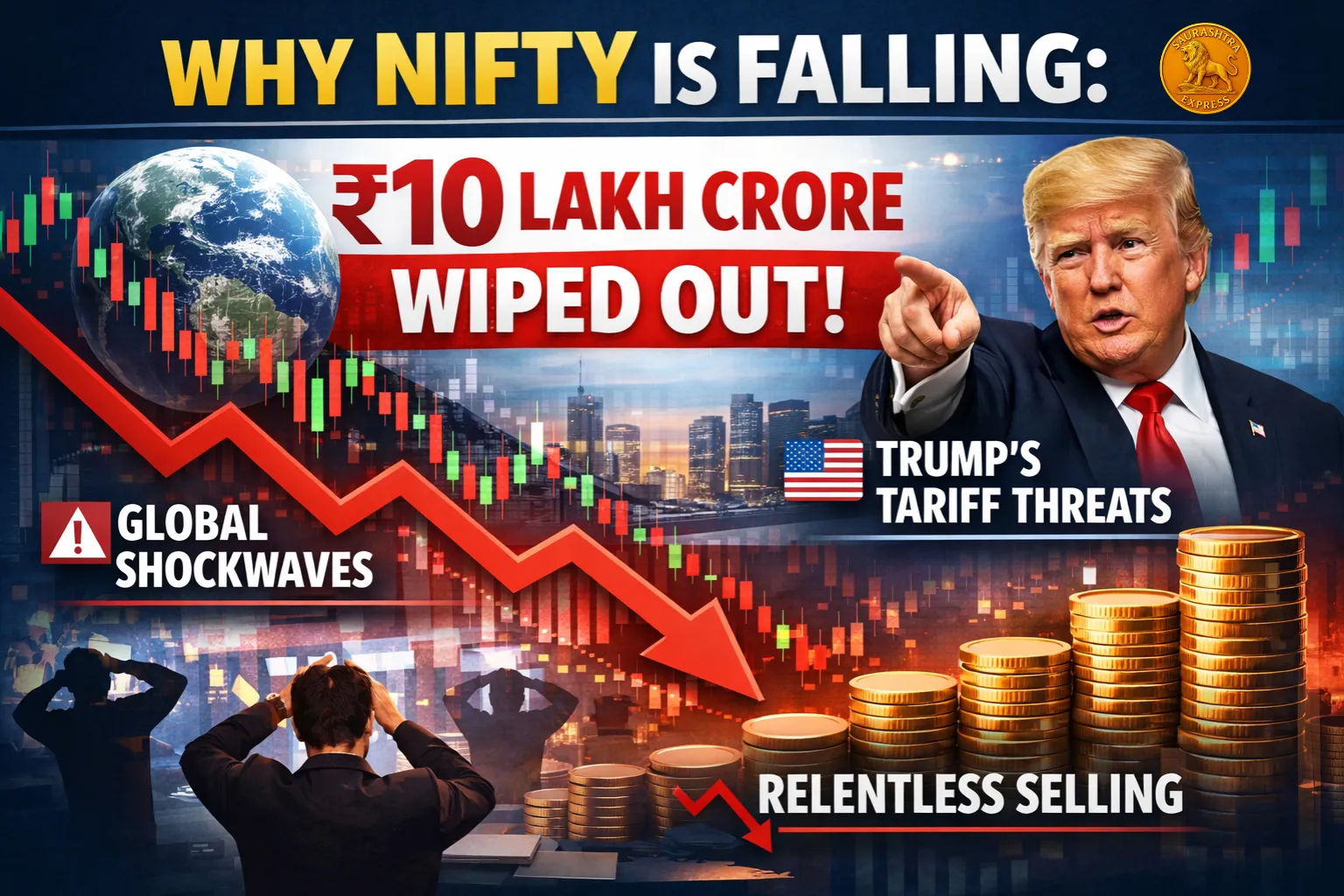
The Indian stock market witnessed one of its most unsettling sessions in recent months as panic selling erased massive investor wealth in a single stroke. In just one trading day, nearly ₹10.12 lakh crore vanished from the market, leaving investors shaken and analysts scrambling to assess the damage. Benchmark indices Sensex and Nifty ended deep in the red, extending losses for the second consecutive session and raising a critical question dominating financial circles today: Why Nifty is falling so sharply?
On Tuesday, the Sensex plunged 1,065 points to close at 82,180.47, while the Nifty slipped 353 points to settle at 25,232.50. The carnage was not limited to headline indices. The Bank Nifty shed 487 points, and during intraday trade, the Sensex had fallen by as much as 1,200 points, with Nifty dropping nearly 400 points at its lowest level of the day.
This sharp decline was driven by a toxic mix of global geopolitical tensions, aggressive foreign investor selling, renewed fears of a global trade war, and a decisive shift of capital towards safe-haven assets like gold and silver. Together, these factors have created an environment of heightened uncertainty that continues to pressure Indian equities.
A Day of Destruction: ₹10.12 Lakh Crore Gone in Hours
The scale of losses on Dalal Street was staggering. On Monday, the total market capitalization of companies listed on the BSE stood at ₹465.68 lakh crore. By the close of trading on Tuesday, this figure had shrunk to ₹455.72 lakh crore. In other words, investors lost over ₹10.12 lakh crore in a single session.
For retail investors, mutual fund holders, and even large institutions, the speed and magnitude of the sell-off were deeply unsettling. Portfolios that had been built over months or years saw sharp erosion in value within hours, underscoring how fragile market sentiment has become.
Only One Survivor Among Sensex Heavyweights
The selling pressure was broad-based and unforgiving. Out of the 30 Sensex constituents, only one stock managed to end the session in positive territory. HDFC Bank emerged as the lone gainer, while the remaining 29 stocks closed with losses.
Zomato bore the brunt of the sell-off, plunging over 4 percent as investors dumped high-valuation and risk-sensitive stocks. Other heavyweight names such as Bajaj Finance, Sun Pharma, IndiGo, Reliance Industries, and TCS also witnessed sharp declines, adding significant weight to the benchmark indices.
The widespread nature of the decline is a key reason why Nifty is falling, as it signals not just stock-specific weakness but a systemic risk-off mood gripping the market.
All Sectors in the Red: No Place to Hide
Tuesday’s sell-off spared no sector. On the NSE, every single sectoral index ended in negative territory, reflecting deep and pervasive pessimism.
- Realty stocks were the worst hit, with the sector plunging more than 5 percent as rising uncertainty and higher interest rate concerns weighed heavily on property-related companies.
- Auto stocks dropped around 2.5 percent, pressured by fears of slowing global demand and higher input costs.
- Financial stocks, including banks and NBFCs, declined about 1.4 percent despite relatively stable domestic fundamentals.
- Other sectors such as FMCG, metals, pharma, and energy also slipped by around 1 percent or more.
When all sectors fall together, it reinforces the perception that the market is reacting to macro-level risks rather than company-specific issues. This sector-wide decline is a major explanation behind why Nifty is falling so decisively.
IT Stocks Trigger Fresh Panic
One of the most significant contributors to the market’s weakness was heavy selling in IT stocks. The IT sector, which is highly sensitive to global economic signals and currency movements, came under intense pressure as fears of a slowdown in the US and Europe resurfaced.
Shares of Wipro fell nearly 3 percent, while LTIMindtree plunged as much as 6 percent. Other IT majors also traded lower, dragging the Nifty IT index sharply down and pushing the broader market to its lowest levels in nearly two months.
Investors are increasingly worried that a potential escalation in global trade tensions could hurt technology spending by international clients, particularly in North America and Europe, which are key revenue markets for Indian IT firms.
Trump, Greenland, and the Return of Trade War Fears
One of the most unexpected and destabilizing triggers behind the current market turmoil has been renewed geopolitical tension involving the United States and Europe.
US President Donald Trump has once again made headlines by pushing for American control over Greenland, a move that has met stiff resistance from several European Union member states. In response, Trump has threatened to impose new tariffs on imports from eight EU countries that oppose the plan.
Even more alarming for global markets was Trump’s warning of a potential 200 percent tariff on French imports. This aggressive stance has reignited fears of a full-blown trade war between the US and Europe, reminiscent of the trade tensions that rattled global markets in earlier years.
The prospect of escalating tariffs has sent shockwaves across global financial markets, as investors worry about disruptions to global supply chains, higher inflation, and slower economic growth. These concerns have spilled over into Indian markets, contributing significantly to why Nifty is falling despite relatively stable domestic indicators.
Global Uncertainty Takes Centre Stage
The current market correction cannot be understood without acknowledging the broader backdrop of rising global uncertainty. Geopolitical tensions, unpredictable policy moves, and fragile economic recovery in major economies have created a volatile environment where investors are increasingly risk-averse.
Following Trump’s tariff threats, European Union leaders have announced an emergency summit in Brussels to discuss the situation and potential countermeasures. The possibility of retaliatory tariffs and prolonged trade disputes has only heightened anxiety in global markets.
For emerging markets like India, such global shocks often lead to capital outflows as investors seek safety in developed markets or non-risk assets. This dynamic plays a crucial role in explaining why Nifty is falling even when domestic growth prospects remain comparatively strong.
FIIs Continue Relentless Selling
Another major factor weighing heavily on Indian equities is the sustained selling by foreign institutional investors (FIIs). On Monday alone, FIIs sold shares worth approximately ₹3,263 crore, marking the tenth consecutive trading session of net selling.
The trend has been even more pronounced over the past month. In December 2025, FIIs sold Indian equities worth a massive ₹34,350 crore. Although domestic institutional investors (DIIs) attempted to stabilize the market by purchasing shares worth ₹79,620 crore during the same period, their efforts have not been sufficient to fully offset the impact of foreign outflows.
FIIs are particularly sensitive to global interest rates, currency movements, and geopolitical risks. With the US dollar strengthening and global uncertainty rising, many foreign investors are reducing exposure to emerging markets, including India. This persistent FII selling is one of the clearest reasons why Nifty is falling despite strong participation from domestic investors.
Flight to Safety: Gold and Silver Shine
As equities crumble, investors are increasingly turning towards traditional safe-haven assets. Gold prices have surged dramatically, crossing $4,700 per ounce for the first time in history. Silver has also climbed to record highs.
This shift of capital away from equities and into precious metals reflects deep-seated fear in the market. When investors prioritize capital preservation over growth, stock markets typically suffer. The strong rally in gold and silver is therefore both a symptom and a cause of the ongoing equity sell-off.
The movement of funds into safe assets further drains liquidity from equity markets, exacerbating declines and reinforcing negative sentiment. This trend offers yet another answer to the question of why Nifty is falling at such a rapid pace.
Global Markets Mirror the Weakness
Indian markets were not alone in facing selling pressure. Global equity markets also ended mostly lower, reflecting widespread concern over geopolitical risks and economic uncertainty.
- South Korea’s Kospi index fell 0.39 percent to close at 4,885.
- Japan’s Nikkei dropped 1.11 percent to 52,991.
- Hong Kong’s Hang Seng slipped 0.29 percent to 26,487.
- China’s Shanghai Composite edged down 0.085 percent to 4,113.
In the United States, markets closed slightly lower on January 19. The Dow Jones fell 0.17 percent to 49,359, while the Nasdaq and S&P 500 declined marginally by 0.062 percent and 0.064 percent, respectively.
These global cues further dampened sentiment on Dalal Street, reinforcing fears that the current downturn could persist if international conditions worsen.
Looking Back: Markets Were Already Under Pressure
The sharp fall on Tuesday came on the heels of losses in the previous session, indicating that the market was already on shaky ground. On December 19, the Sensex had declined by 324 points to close at 83,246, while the Nifty fell 108 points to end at 25,585.
This back-to-back decline suggests that the market’s correction is not a one-day phenomenon but part of a broader trend driven by accumulating risks. The sudden escalation in global tensions merely acted as a trigger for a sell-off that had been building beneath the surface.
Why Nifty Is Falling: The Bigger Picture
To understand why Nifty is falling, it is essential to look beyond daily price movements and focus on the underlying forces at play. These include:
- Escalating global geopolitical tensions, particularly between the US and Europe
- Renewed fears of a global trade war driven by aggressive tariff threats
- Sustained selling by foreign institutional investors
- Weakness in global equity markets
- Heavy selling in IT and high-valuation stocks
- A decisive shift of investor capital towards safe-haven assets
Together, these factors have created a perfect storm that has overwhelmed positive domestic fundamentals and pushed Indian markets sharply lower.
What Lies Ahead for Investors?
Market experts caution that volatility is likely to remain elevated in the near term. Much will depend on how global events unfold, particularly the outcome of discussions between the US and European Union and the future direction of trade policies.
Investors are advised to remain cautious, avoid panic selling, and focus on long-term fundamentals rather than short-term market noise. While sharp corrections can be painful, they also present opportunities for disciplined investors to accumulate quality stocks at more reasonable valuations.
For now, however, uncertainty dominates the landscape. Until clarity emerges on global geopolitical risks and foreign investor flows stabilize, the question of why Nifty is falling will continue to dominate headlines and investor conversations alike.
Conclusion
The massive sell-off that wiped out over ₹10 lakh crore in a single day serves as a stark reminder of how interconnected global markets have become. Even strong domestic economies are not immune to shocks originating thousands of miles away.
As geopolitical tensions rise, trade war fears resurface, and investors seek safety over growth, Indian markets are facing one of their toughest tests in recent times. Understanding why Nifty is falling is not just about analyzing charts and numbers but about recognizing the broader forces shaping today’s global financial system.
Whether this downturn deepens or stabilizes will depend on developments in the coming days. Until then, caution, patience, and perspective remain the most valuable assets for investors navigating these turbulent markets.