
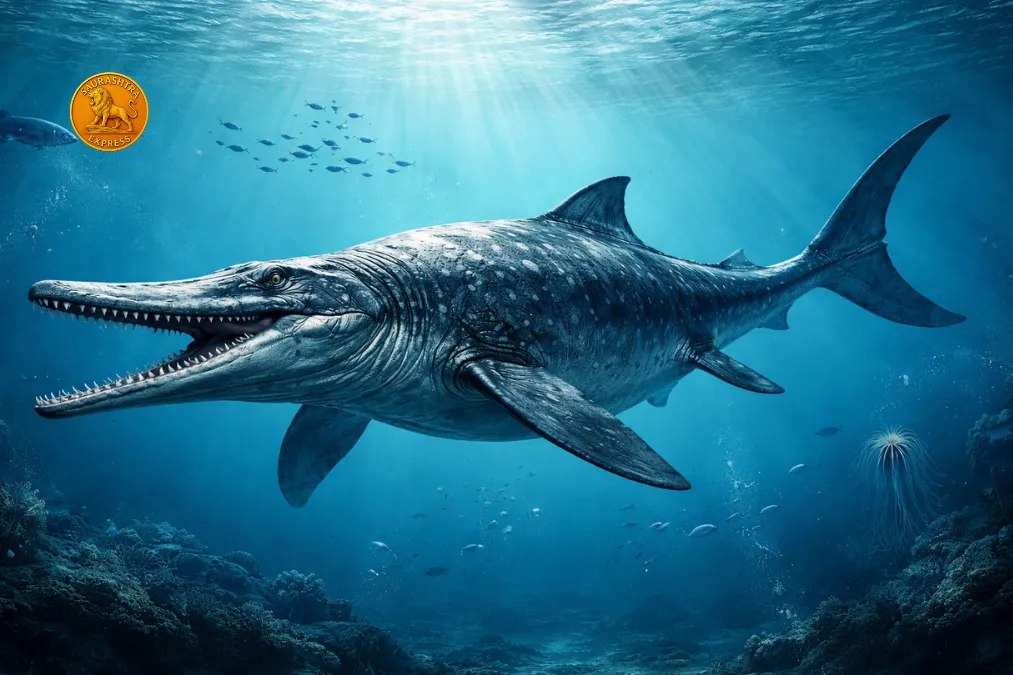
World Largest Ocean Animal: A remarkable discovery along the coast of Somerset has sent ripples through the global scientific community, raising fresh questions about what truly qualifies as the World Largest Ocean Animal. What makes this story even more extraordinary is that the breakthrough did not come from a seasoned paleontologist—but from an 11-year-old girl exploring a beach during the COVID-19 lockdown.
This unexpected find has led scientists to identify a previously unknown prehistoric marine reptile, now named Ichthyotitan severnensis—a creature that may rival, or even challenge, the size of the modern-day Blue whale.
A Lockdown Discovery That Changed Science
In May 2020, during the global COVID-19 lockdown, young Ruby Reynolds and her father Justin were walking along the beach at Blue Anchor. Like many families confined indoors for months, they had turned to nature for a sense of exploration and relief.
What began as a simple outing soon turned into a historic moment.
While examining the muddy shoreline, Ruby noticed a large, unusual piece of bone partially buried in sediment. Her father spotted another fragment nearby. At first glance, the pieces seemed like ordinary fossils—but closer inspection revealed something far more significant.
Scientists would later confirm that these fragments were part of a massive lower jaw belonging to an unknown prehistoric marine creature.
Understanding Fossils: Windows Into Earth’s Ancient Past
Before diving deeper into the discovery, it is important to understand what fossils are and why they matter.
Fossils are preserved remains or traces of ancient organisms that lived millions of years ago. These can include bones, teeth, shells, or even imprints of plants and microscopic organisms. Over time, these remains become buried under layers of sediment and gradually turn into stone.
Fossils provide invaluable insights into:
- Evolutionary history
- Ancient ecosystems
- Extinct species
- Climate changes over millions of years
Ruby’s discovery is a textbook example of how even a single fossil fragment can reshape our understanding of life on Earth.
The Giant Jaw That Shocked Scientists
The fossil Ruby found turned out to be part of a lower jaw measuring more than two meters in length. This alone was enough to suggest that the creature it belonged to was enormous.
After detailed examination by paleontologists, the fossil was identified as belonging to a new species of ichthyosaur—a group of marine reptiles that lived during the age of dinosaurs.
The newly named Ichthyotitan severnensis translates roughly to “giant fish lizard of the Severn,” referencing both its immense size and its proximity to the Severn Estuary.
What Are Ichthyosaurs?
Ichthyosaurs were marine reptiles that dominated Earth’s oceans millions of years ago. Although they lived during the dinosaur era, they were not dinosaurs themselves.
They had a unique appearance, resembling a mix between:
- Dolphins
- Sharks
- Modern reptiles
Key Characteristics of Ichthyosaurs:
| Feature | Description |
|---|---|
| Body Shape | Streamlined for fast swimming |
| Snout | Long and pointed, ideal for catching prey |
| Limbs | Strong flippers for navigation |
| Eyes | Large, adapted for deep-sea vision |
| Diet | Carnivorous, feeding on fish and squid |
These creatures were among the top predators of prehistoric oceans, playing a crucial role in maintaining marine ecosystems.
Could This Be the World Largest Ocean Animal?
The most fascinating aspect of this discovery is its potential to challenge the long-standing title of the World Largest Ocean Animal, currently held by the Blue whale.
Size Comparison
| Creature | Estimated Length | Status |
|---|---|---|
| Blue Whale | Up to 30 meters (98 feet) | Largest known living animal |
| Ichthyotitan severnensis | Around 25 meters (82 feet) | Newly discovered prehistoric species |
While the Blue whale remains the largest confirmed animal in history, the newly discovered ichthyosaur comes surprisingly close.
Scientists believe that if more complete fossils are found, this prehistoric giant could potentially rival or even surpass the Blue whale in size.
A Puzzle Completed Years Later
Interestingly, Ruby’s discovery was not the first clue.
Back in 2016, researchers had uncovered another massive ichthyosaur jaw fragment near Lilstock, located about 10 kilometers from Blue Anchor. However, that fossil was incomplete, leaving scientists uncertain about its origin.
When Ruby’s fossil was analyzed and compared with the earlier find, researchers realized something remarkable:
Both fragments belonged to the same species.
This breakthrough allowed scientists to piece together a clearer picture of the creature and officially classify it as a new species.
Life 202 Million Years Ago
Researchers estimate that Ichthyotitan severnensis lived approximately 202 million years ago, during the late Triassic period—just before a major extinction event known as the Triassic–Jurassic extinction event.
This period was a time of dramatic environmental change, with volcanic activity, climate shifts, and mass extinctions reshaping life on Earth.
Despite these challenges, giant marine reptiles like Ichthyotitan thrived in the oceans.
Why This Discovery Matters
The discovery of Ichthyotitan severnensis is significant for several reasons:
1. Rethinking Marine Evolution
Previously, scientists believed that giant ichthyosaurs had already disappeared before the end of the Triassic period. This discovery proves otherwise.
2. Understanding Ocean Ecosystems
The existence of such massive predators suggests that ancient oceans were rich in food and had relatively low competition.
3. Insights Into Gigantism
Scientists are now exploring why certain marine animals evolved to such enormous sizes—something that continues even today with whales.
4. Citizen Science at Its Best
Perhaps most inspiring is the role of a young girl in this discovery. It highlights how curiosity and observation can contribute to major scientific breakthroughs.
The Role of Environment in Giant Marine Life
Ancient oceans were vastly different from today’s seas. Several factors allowed massive creatures to thrive:
- Abundant prey species
- Stable ocean temperatures
- Fewer competing predators
- High oxygen levels
These conditions created the perfect environment for creatures that could grow to sizes comparable to the World Largest Ocean Animal.
From Beach Walk to Scientific Paper
Ruby Reynolds’ discovery did not just make headlines—it earned her a place in scientific history.
She later became a co-author of the research paper describing Ichthyotitan severnensis, an extraordinary achievement for someone so young.
Her journey demonstrates that science is not limited to laboratories—it can begin anywhere, even on a quiet beach walk.
How Scientists Study Fossils
After a fossil is discovered, it goes through several stages of analysis:
- Collection – Carefully removing the fossil from its location
- Preservation – Protecting it from damage
- Identification – Comparing with known species
- Dating – Determining its age using geological methods
- Reconstruction – Estimating the full structure of the organism
In this case, multiple visits between 2020 and 2022 helped researchers gather additional fragments and refine their understanding.
The Ongoing Search for the World Largest Ocean Animal
The question of what truly qualifies as the World Largest Ocean Animal remains open-ended.
While the Blue whale holds the current title, discoveries like Ichthyotitan severnensis remind us that Earth’s history still holds many secrets.
Future fossil discoveries may:
- Reveal even larger prehistoric species
- Redefine size comparisons
- Provide deeper insights into evolution
Key Facts at a Glance
| Category | Details |
|---|---|
| Discovery Year | 2020 |
| Discoverer | Ruby Reynolds (age 11) |
| Location | Somerset, England |
| Species Name | Ichthyotitan severnensis |
| Estimated Length | Up to 25 meters |
| Time Period | Late Triassic (202 million years ago) |
| Type | Marine reptile (Ichthyosaur) |
A Reminder of Nature’s Hidden Wonders
This discovery serves as a powerful reminder that even in the modern world, there are still mysteries waiting to be uncovered.
From ancient fossils buried beneath mud to massive creatures that once ruled the oceans, Earth continues to surprise us.
And sometimes, all it takes is curiosity—and a sharp eye—to change what we thought we knew about the World Largest Ocean Animal.
Disclaimer
This article is based on available scientific research and global media reports. Findings related to marine biology and paleontology may evolve as new discoveries emerge. Readers are encouraged to consult official scientific publications and i