
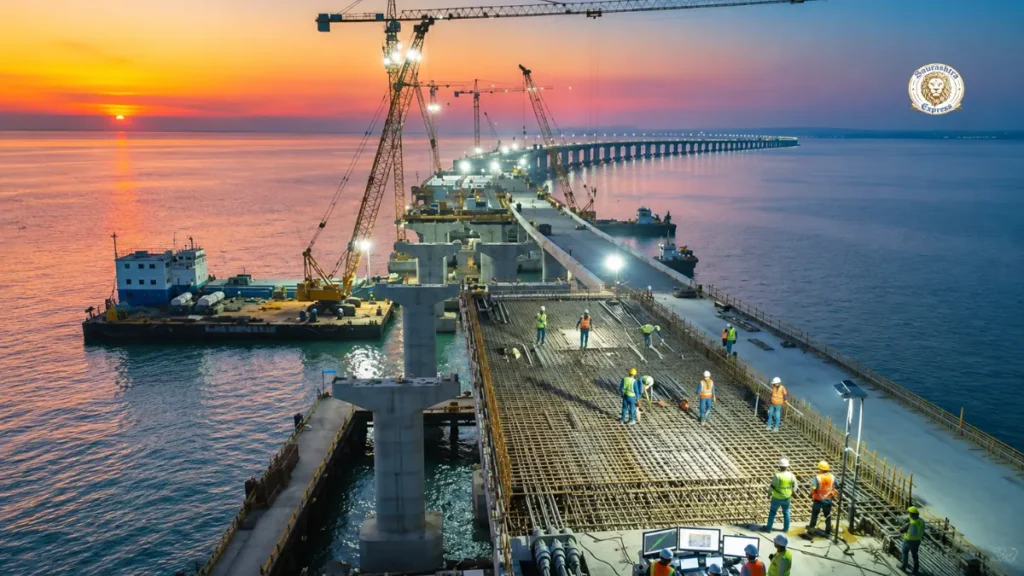
DPR Process: The long-awaited plan to build a massive sea bridge across the Gulf of Khambhat has moved a step closer to reality, with the Detailed Project Report (DPR) Process officially underway. The proposed bridge, which is expected to stretch around 30 kilometers across the gulf, forms a key component of the ambitious Jamnagar–Bhavnagar–Bharuch Expressway project in Gujarat.
The project is being seen as a major infrastructure initiative that could transform transportation, trade, and industrial connectivity across the state. Once completed, the bridge is expected to become the longest sea bridge in India, surpassing the existing record held by Mumbai’s Atal Setu.
International Interest in the DPR Process
The Ministry of Road Transport and Highways (MoRTH) has initiated the DPR Process to assess the technical, environmental, and economic feasibility of the project. Several international engineering and infrastructure firms have shown interest in preparing the report.
Among the companies that have submitted technical bids are Bloom Companies LLC from the United States and Russia-based Institute Giprostroymost. These firms are participating in the early-stage evaluation process, which includes technical surveys, route planning, environmental impact assessments, and studies related to land acquisition.
The DPR Process is considered one of the most critical phases of any major infrastructure project, as it determines the design, cost estimates, engineering requirements, and long-term viability of construction. Once the report is finalized and approved, authorities are expected to invite global tenders for the construction phase.
Strategic Expressway to Connect Key Regions
The proposed expressway corridor connecting Jamnagar, Rajkot, Bhavnagar, and Bharuch is expected to span approximately 316 kilometers. Planned as a high-speed four-to-six-lane corridor, the route aims to strengthen connectivity between Saurashtra and South Gujarat while reducing travel time and transportation costs.
The project has been divided into two major segments for the DPR Process. The first package covers the 248-kilometer stretch between Jamnagar, Rajkot, and Bhavnagar, while the second package includes the 68-kilometer section between Bhavnagar and Bharuch.
Transportation experts believe the new corridor could significantly improve movement of goods and passengers across the state, supporting Gujarat’s growing industrial and manufacturing sectors.
Travel Time Set for Dramatic Reduction
One of the most significant benefits of the proposed sea bridge is the reduction in travel distance between Bhavnagar and Bharuch. At present, motorists typically travel through Bagodara or Vadodara, covering around 357 kilometers and spending seven to eight hours on the journey.
With the completion of the bridge, the distance is expected to shrink to approximately 114 kilometers. Travel time could be reduced to as little as 45 minutes to one hour, offering substantial savings in fuel, logistics expenses, and overall transportation efficiency.
Such improvements are expected to benefit both individual travelers and commercial transport operators, making movement across the region faster and more economical.
Potential Boost for Gujarat’s Industrial Growth
The project is also expected to provide direct advantages to some of Gujarat’s most important industrial zones. Major industrial centers such as Alang Ship Breaking Yard, the Dholera semiconductor and industrial hub, Ankleshwar, and Hazira are likely to gain from improved connectivity and reduced logistics costs.
Industry stakeholders have long advocated for better transport infrastructure linking Saurashtra with South Gujarat. Faster freight movement and more efficient supply chains could enhance competitiveness for businesses operating in these regions.
There is also growing speculation that the proposed infrastructure could complement broader coastal development initiatives in Gujarat, including projects associated with the Kalpasar concept, although no official integration has yet been confirmed.
Also read: Kandla Port Tragedy: Three Workers Die After Suspected Toxic Gas Exposure on Cargo Ship
Key Highlights of the Project
- Proposed sea bridge length: Approximately 30 km
- Part of the Jamnagar–Bhavnagar–Bharuch Expressway
- Total expressway length: Around 316 km
- Travel distance between Bhavnagar and Bharuch expected to reduce from 357 km to 114 km
- Journey time could fall from 7–8 hours to less than one hour
- Likely to become India’s longest sea bridge upon completion
- Expected to support industrial hubs including Alang, Dholera, Ankleshwar, and Hazira
As the DPR Process progresses, the Gulf of Khambhat Sea Bridge is emerging as one of Gujarat’s most closely watched infrastructure projects. If executed as planned, it could reshape regional connectivity and play a significant role in the state’s future economic development.