
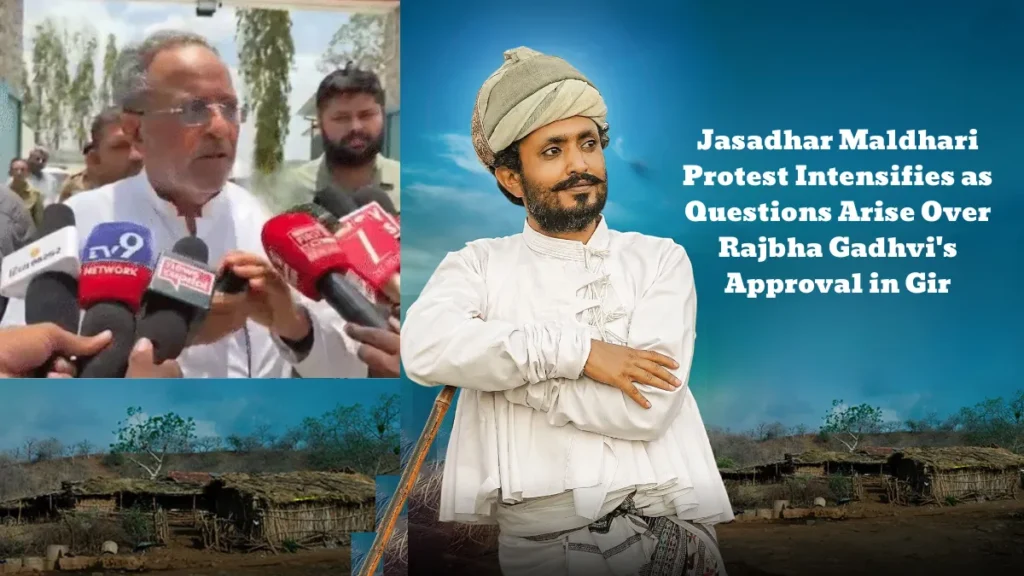
Jasadhar Maldhari Protest: A growing controversy in Gujarat‘s Gir region has triggered protests among members of the Maldhari community after folk artist Rajbha Gadhvi was granted permission to be recognized as a Maldhari resident in a forest settlement. The issue, now widely referred to as the Jasadhar Maladhari Protest, has raised concerns about transparency, consistency in decision-making, and the criteria used by forest authorities when approving such applications.
The dispute has also attracted political attention after Gujarat Forest and Environment Minister Arjun Modhwadia declined to answer questions from reporters regarding the matter during a recent visit to the Gir East region.
Approval Granted After Earlier Application Was Rejected
The controversy centers on an application linked to Rajbha Gadhvi’s family in the Gir East Forest Division. According to information shared by protesting Maldharis, an application submitted in 2023 in the name of Gadhvi’s father for recognition as a Maldhari resident in Lilipani Nes, located within the Paniya Range, was rejected by forest authorities.
At the time, officials reportedly cited eligibility-related concerns. One of the key reasons mentioned was that the applicant had previously received government land, while regulations governing Maldhari settlements require applicants to meet specific conditions related to land ownership and residency status.
However, the situation changed in 2026 when Rajbha Gadhvi submitted a fresh application. Forest authorities approved the request, leading to immediate objections from several Maldhari families who argued that similar applications from other community members had not received the same treatment.
Maldhari Community Seeks Equal Consideration
The approval prompted members of the Maldhari community to travel to Gandhinagar and submit representations to government authorities. Protesters claimed that many families possess documentation and evidence comparable to those used in Gadhvi’s case but have not been granted similar approvals.
Community representatives speaking to the media questioned why some applications move forward while others remain pending or are rejected. They called for a transparent review process and demanded that authorities clearly explain the standards being applied.
The protesting groups emphasized that their primary concern is fairness rather than opposition to any individual applicant. They argued that all eligible Maldharis should be assessed using the same criteria and that decisions affecting traditional forest communities should be publicly justified.
Minister Avoids Comment During Media Interaction
The issue gained further attention when journalists attempted to question Forest Minister Arjun Modhwadia during his visit to the Gir East region. Reporters sought clarification regarding the approval granted to Rajbha Gadhvi and the ongoing protests by Maldhari groups.
According to those present, the minister chose not to respond to the questions and ended the interaction without offering a statement on the controversy. Videos of the exchange later circulated on social media, fueling further debate and public discussion about the issue.
The lack of an official response has led protesters to renew calls for greater accountability from both elected representatives and forest department officials.
Questions Raised Over Administrative Decision-Making
Adding to the controversy are claims that local-level officials had reportedly expressed reservations about the application before approval was ultimately granted. Protesters and some local sources allege that despite an unfavorable assessment at the range level, higher authorities approved the application.
These allegations have not been officially confirmed by the forest department. Nevertheless, the claims have intensified scrutiny of the decision-making process and prompted demands for a detailed explanation from senior officials.
Critics argue that public confidence in administrative decisions depends on consistency and transparency, particularly in sensitive matters involving forest settlements and traditional communities. Supporters of the protest say the government should release clear guidelines and explain how the approval was evaluated.
Debate Likely to Continue
As the Jasadhar Maladhari Protest continues, the issue has evolved beyond a single application and now reflects broader concerns within the Maldhari community about equal treatment and administrative transparency.
With community groups seeking answers and officials yet to provide a detailed public clarification, the controversy is expected to remain a subject of discussion in the coming weeks. Many stakeholders are now calling for an impartial review of the approval process to ensure that future decisions are made fairly and consistently for all eligible applicants.