
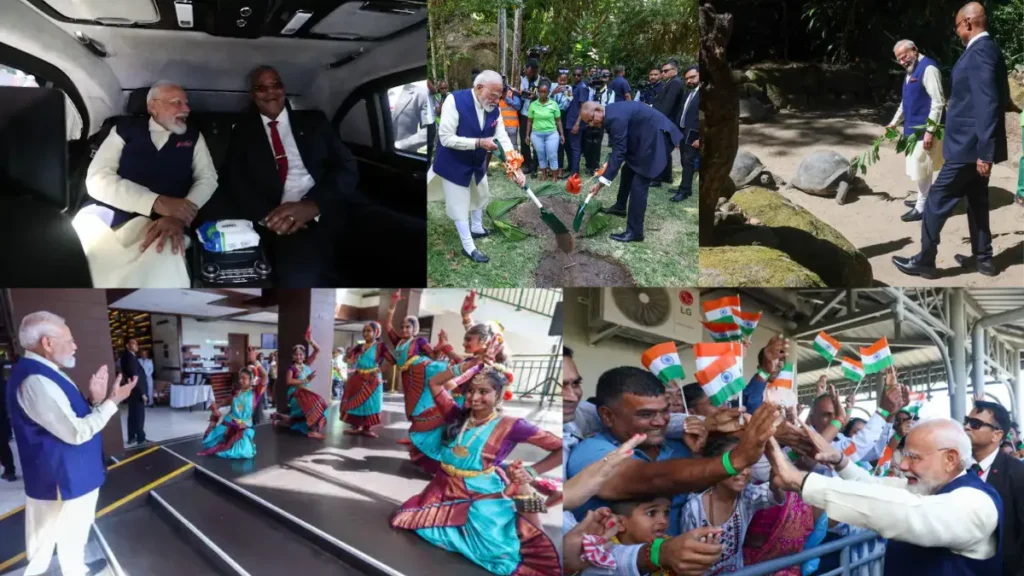
PM Narendra Modi Seychelles Visit has drawn international attention as the Indian Prime Minister began a three-day visit to the Indian Ocean island nation, highlighting decades of diplomatic cooperation, deep historical connections, and a shared vision for maritime security. The visit comes at a landmark moment, with India and Seychelles celebrating 50 years of diplomatic relations while looking ahead to stronger economic, strategic, and cultural partnerships.
Prime Minister Narendra Modi arrived in the Seychelles capital, Victoria, on Saturday, where he received a ceremonial welcome from President Patrick Herminie. One of the most memorable moments of the visit came when the two leaders visited the National Botanical Gardens and fed leaves to the world-famous Aldabra giant tortoises, one of the country’s most iconic wildlife species.
Beyond the symbolic gesture, Modi’s visit reflects the growing importance of Seychelles in India’s Indian Ocean strategy. Despite being one of the world’s smallest nations in terms of population, Seychelles occupies a strategic maritime location that has become increasingly significant for regional security, international shipping, and economic cooperation.
A Warm Welcome in Victoria
Prime Minister Modi’s arrival was marked by an official reception attended by senior government officials and dignitaries. The visit is expected to strengthen bilateral relations across several sectors, including maritime security, trade, education, healthcare, renewable energy, and capacity building.
The Indian Prime Minister is also scheduled to participate as the Chief Guest during Seychelles’ 50th National Day celebrations on June 29, making his visit especially significant for both countries.
His engagements include meetings with President Patrick Herminie, members of the National Assembly, government officials, business representatives, and members of the Indian-origin community living in Seychelles.
A Memorable Visit to the National Botanical Gardens
One of the highlights of the visit was Modi’s tour of the National Botanical Gardens in Victoria.
Alongside President Herminie, he spent time observing the famous Aldabra giant tortoises before feeding them fresh leaves. Images from the event quickly attracted attention because these gentle giants are among Seychelles’ most recognizable natural treasures.
The interaction reflected not only the country’s commitment to wildlife conservation but also the friendly atmosphere surrounding the visit.
Unlike formal diplomatic meetings, such moments often create a lasting impression by showcasing the cultural and environmental heritage of the host nation.
Why the Aldabra Giant Tortoise Is Famous Worldwide
The Aldabra giant tortoise is among the largest tortoise species on Earth and is native to Seychelles’ Aldabra Atoll, a UNESCO World Heritage Site.
Known for their enormous size and extraordinary lifespan, these reptiles often live well beyond 100 years. Many individuals survive for nearly 150 years, while some have lived considerably longer.
Perhaps the most famous tortoise connected to this species is Jonathan, believed to be the world’s oldest living land animal. Scientists estimate that Jonathan is nearly two centuries old, making him an extraordinary subject for research on longevity and healthy ageing.
Researchers continue studying the genetics of giant tortoises to understand why they age more slowly than many other species. Scientists believe these animals may hold valuable clues that could improve our understanding of ageing and disease resistance.
For Seychelles, the Aldabra giant tortoise is far more than a tourist attraction—it represents the nation’s rich biodiversity and long-standing conservation efforts.
India and Seychelles Share More Than Diplomatic Relations
Although India and Seychelles formally established diplomatic relations five decades ago, their connection stretches back much further.
Historical records indicate that when the first permanent settlement was established in Seychelles during the eighteenth century, five Indians were among the original settlers who arrived with the French expedition.
That remarkable detail highlights the centuries-old relationship between the two societies, long before the modern nation-states existed.
Over time, Indians from different regions, including Bihar, Tamil Nadu, and Gujarat, migrated to Seychelles for trade, agriculture, construction, and business opportunities.
Generations later, these communities became an integral part of Seychellois society while preserving many aspects of their Indian heritage.
The Story of the Indian Community in Seychelles
Today, Seychelles has a population of roughly 120,000 people.
Among them, citizens of Indian origin form an influential and respected community that has contributed significantly to commerce, public administration, education, healthcare, and entrepreneurship.
Many Indian families have lived in Seychelles for generations, creating strong cultural ties between the two nations.
Indian festivals, cuisine, traditional customs, and religious practices continue to be visible across the country, reflecting a multicultural society where different communities have coexisted peacefully.
The presence of the Indian diaspora has also played an important role in strengthening people-to-people relations, often serving as a bridge between New Delhi and Victoria.
President Patrick Herminie’s Visit and Growing Cooperation
Prime Minister Modi noted that President Patrick Herminie’s visit to India earlier this year opened new opportunities for cooperation.
The latest discussions are expected to focus on expanding collaboration in infrastructure development, digital technology, healthcare, education, renewable energy, disaster preparedness, and climate resilience.
As island nations face increasing challenges from rising sea levels and extreme weather events, climate cooperation has become an important pillar of India-Seychelles relations.
India has consistently supported small island developing states by sharing technology, training, financial assistance, and development partnerships.
Maritime Security Remains a Shared Priority
Seychelles occupies an important location in the western Indian Ocean, close to major international shipping routes that carry a substantial portion of global trade.
This strategic geography makes maritime security one of the central themes of India-Seychelles cooperation.
Both countries regularly work together to combat piracy, illegal fishing, maritime crime, drug trafficking, and other security challenges affecting the region.
India has provided patrol vessels, surveillance aircraft, coastal radar systems, training programmes, and technical assistance to help strengthen Seychelles’ maritime capabilities.
These initiatives also contribute to safer sea lanes, benefiting regional commerce and international shipping.
India’s Vision for the Indian Ocean
During the visit, Prime Minister Modi described Seychelles as an important maritime neighbour and a key partner in India’s MAHASAGAR vision for regional cooperation.
India has increasingly focused on strengthening partnerships with island nations across the Indian Ocean through development assistance, humanitarian support, disaster relief, and defence cooperation.
The objective is to promote a region that remains secure, stable, prosperous, and open for peaceful maritime activities.
For Seychelles, cooperation with India supports national development while enhancing its ability to protect its vast Exclusive Economic Zone, which covers a much larger area than its land territory.
Addressing the National Assembly
One of the historic aspects of the visit is Prime Minister Modi’s scheduled address to Seychelles’ National Assembly.
The speech is expected to reaffirm India’s commitment to democratic values, parliamentary cooperation, and mutual respect between the two countries.
Such engagements extend beyond diplomatic symbolism by encouraging greater exchanges between lawmakers, institutions, and policymakers.
Parliamentary cooperation often creates opportunities for collaboration on legislation, governance, digital transformation, public administration, and institutional capacity building.
Economic Opportunities Continue to Expand
Trade between India and Seychelles has steadily diversified over the years.
Indian companies have participated in infrastructure, construction, pharmaceuticals, telecommunications, information technology, banking, and renewable energy projects.
Tourism also remains an important sector.
Indian visitors continue to contribute to Seychelles’ tourism industry, while improved connectivity and growing awareness may encourage more travel in the years ahead.
Education represents another area of cooperation, with many Seychellois students pursuing higher studies in India under scholarship programmes supported by the Indian government.
Medical cooperation has similarly expanded through training, healthcare partnerships, and pharmaceutical exports.
Remembering Earlier Prime Ministerial Visits
Prime Minister Modi’s visit also carries historical significance because very few Indian Prime Ministers have officially visited Seychelles.
Former Prime Minister Indira Gandhi visited the island nation in 1976, the year Seychelles gained independence, and returned again in 1981.
Those visits laid the foundation for long-term political cooperation during the early decades of bilateral relations.
Subsequent years saw continued engagement through high-level delegations, defence partnerships, development assistance, and cultural exchanges.
Modi’s visit represents another important milestone in that evolving relationship.
Shared Democratic Values
India and Seychelles have consistently emphasized democracy, pluralism, rule of law, and peaceful international cooperation.
These shared values have allowed the partnership to grow beyond traditional diplomacy.
From education and healthcare to environmental conservation and maritime security, the relationship has expanded into multiple sectors that directly benefit ordinary citizens.
Officials from both countries believe stronger institutional cooperation will create new opportunities for investment, innovation, and sustainable development.
Looking Ahead
The PM Narendra Modi Seychelles Visit comes at a time when the Indian Ocean region is gaining increasing geopolitical importance.
As global attention shifts toward maritime trade, regional stability, and sustainable development, partnerships between India and island nations such as Seychelles are becoming more significant than ever.
For India, Seychelles is not merely a friendly neighbour but an essential partner in maintaining a secure and prosperous Indian Ocean.
For Seychelles, India remains a trusted development partner with longstanding historical ties, strong people-to-people connections, and a shared commitment to regional peace.
From feeding giant tortoises in the National Botanical Gardens to discussing maritime cooperation, economic growth, climate resilience, and cultural exchanges, Prime Minister Modi‘s visit reflects a relationship built on trust and strengthened through decades of collaboration.
As both nations celebrate fifty years of diplomatic relations while acknowledging a shared history that stretches back more than two centuries, the visit serves as a reminder that enduring partnerships are built not only through strategic interests but also through people, history, and mutual respect.
With several bilateral discussions, public engagements, and ceremonial events scheduled throughout the visit, both governments hope this landmark occasion will open a new chapter in India-Seychelles relations and reinforce their common vision for a peaceful, secure, and prosperous Indian Ocean region.