
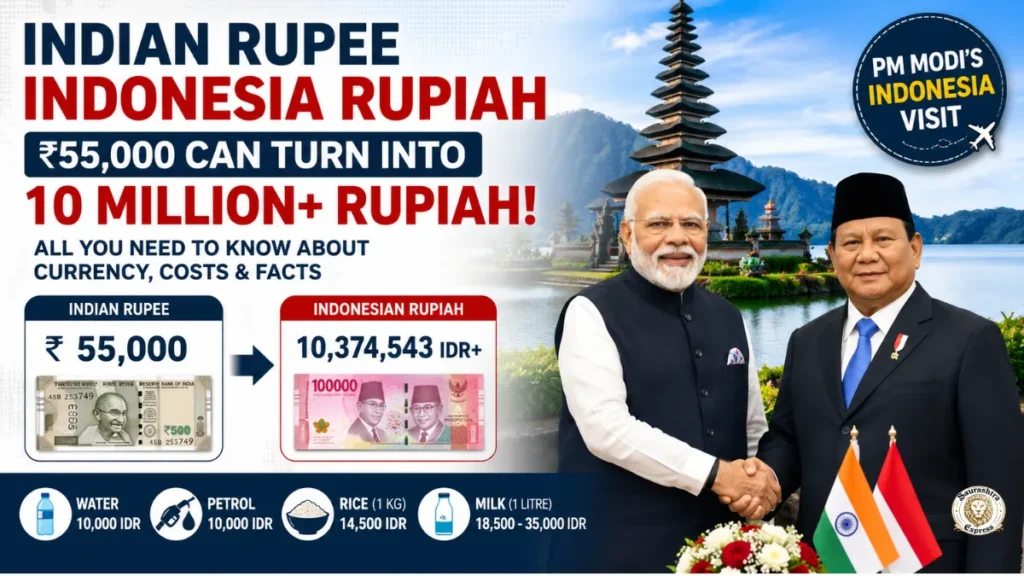
Indian Rupee Indonesia Rupiah: As Prime Minister Narendra Modi’s official visit to Jakarta draws attention to India-Indonesia relations, another topic has captured the interest of Indian travelers and internet users-the remarkable exchange rate between the Indian Rupee and the Indonesian Rupiah. Searches related to Indian Rupee Indonesia Rupiah have surged online as many people are surprised to learn that a relatively modest amount in Indian currency can convert into millions of Indonesian rupiah.
At first glance, the numbers may seem extraordinary. Around ₹55,000 can be exchanged for more than 10 million Indonesian rupiah, giving visitors the impression that they have suddenly become millionaires. However, financial experts point out that these large figures are a result of the rupiah’s denomination rather than an indication of greater purchasing power.
PM Modi’s Jakarta Visit Sparks Interest in Indonesia
Prime Minister Narendra Modi’s visit to Jakarta has renewed focus on the growing partnership between India and Indonesia. The visit is expected to strengthen cooperation in areas such as trade, maritime security, investment, and regional connectivity.
The diplomatic engagement has also encouraged many Indians to learn more about Indonesia, its economy, tourism sector, and local currency. Bali, one of Indonesia’s most famous islands, has already become a favorite destination for Indian tourists, and the latest developments have added to public curiosity about travel costs and currency exchange.
Along with discussions about bilateral relations, online searches related to Indonesia’s currency and cost of living have increased significantly, particularly among people planning overseas vacations.
Understanding the Indian Rupee Indonesia Rupiah Exchange Rate
One of the biggest reasons behind the growing interest is the substantial numerical difference between the two currencies.
Based on recent exchange rates, approximately ₹55,000 converts to more than 10 million Indonesian rupiah (IDR). Although this sounds impressive, it does not mean the money has gained extraordinary purchasing power. Indonesia’s currency is issued in much larger denominations than the Indian rupee, which explains why exchange conversions result in figures running into millions.
Currency values differ widely from country to country due to factors such as inflation history, monetary policy, and economic conditions. Indonesia’s rupiah has long been a high-denomination currency, making everyday prices appear much larger than what many foreign visitors are accustomed to seeing.
Why You Feel Like a Millionaire in Indonesia
Receiving millions of rupiah after exchanging Indian currency can certainly create the feeling of instant wealth. However, this is largely psychological rather than financial.
For example, if someone exchanges ₹55,000 and receives more than 10 million rupiah, they may technically become a “millionaire” in terms of currency units. But everyday goods and services in Indonesia are also priced in thousands or even tens of thousands of rupiah.
This means that while the number displayed on cash notes or bank balances looks enormous, the actual purchasing power remains comparable to local living costs.
Economists often describe this difference by distinguishing between currency denomination and real purchasing power. The number of zeros in a currency does not determine how much wealth a person actually possesses.
Everyday Costs in Indonesia
Visitors to Indonesia quickly notice that routine purchases involve large numerical amounts. Prices for common consumer goods are typically quoted in thousands of rupiah.
Some approximate examples include:
- A 1.5-litre bottle of drinking water: around 10,000 Indonesian rupiah
- One litre of petrol: approximately 10,000 Indonesian rupiah
- One kilogram of rice: about 14,500 Indonesian rupiah
- One litre of milk: generally between 18,500 and 35,000 Indonesian rupiah, depending on the brand and retailer
Although these prices appear high when viewed only as numbers, they reflect Indonesia’s currency structure rather than unusually expensive goods.
For travelers, it is often more useful to compare prices after converting them into Indian rupees instead of focusing solely on the rupiah figures.
Bali Continues to Attract Indian Tourists
Indonesia has become one of the fastest-growing international destinations for Indian travelers, with Bali remaining the country’s biggest attraction.
The island is known for its beaches, temples, volcanic landscapes, cultural experiences, and luxury resorts that cater to a wide range of budgets. Direct flight connectivity from India and competitive travel packages have further increased its popularity.
Understanding the Indian Rupee Indonesia Rupiah exchange rate can help tourists plan their travel budgets more effectively. While visitors receive millions of rupiah after currency exchange, they should still account for accommodation, transportation, food, sightseeing, and shopping expenses based on local prices.
Travel experts recommend exchanging currency through authorized channels and checking live exchange rates before departure, as foreign exchange values fluctuate regularly.
Modi Receives Warm Welcome in Jakarta
Prime Minister Modi’s arrival in Jakarta also highlighted the close diplomatic relationship between the two nations.
Indonesia’s President Prabowo Subianto personally welcomed the Indian Prime Minister, a gesture widely viewed as reflecting the importance both countries attach to their strategic partnership. The visit includes high-level discussions aimed at expanding cooperation in multiple sectors, including commerce, maritime affairs, defense, and regional development.
India and Indonesia have steadily strengthened ties over the years, with both countries playing significant roles in the Indo-Pacific region. Their cooperation extends beyond trade to areas such as digital technology, infrastructure, energy, and cultural exchange.
Growing Opportunities for Travel and Business
As diplomatic engagement continues to deepen, experts believe stronger bilateral ties could encourage greater tourism, business collaboration, and investment between the two countries.
Indonesia already offers Indian travelers visa facilities that make tourism relatively convenient, and continued cooperation may further improve travel connectivity and people-to-people exchanges in the future.
For businesses, Indonesia represents one of Southeast Asia’s largest economies, creating opportunities in manufacturing, technology, renewable energy, and services.
The Bottom Line
The growing attention surrounding the Indian Rupee Indonesia Rupiah exchange rate has revealed an interesting aspect of international currencies. While ₹55,000 may convert into more than 10 million Indonesian rupiah, this does not translate into extraordinary purchasing power. Instead, it reflects the rupiah’s high-denomination currency system, where everyday goods are also priced in thousands of rupiah.
Prime Minister Narendra Modi’s visit to Jakarta has not only reinforced diplomatic ties between India and Indonesia but has also sparked wider public interest in the country’s economy, tourism, and currency. For travelers, understanding how exchange rates relate to actual living costs is essential for planning a realistic and enjoyable trip rather than being influenced solely by the impressive number of zeros on Indonesian banknotes.