
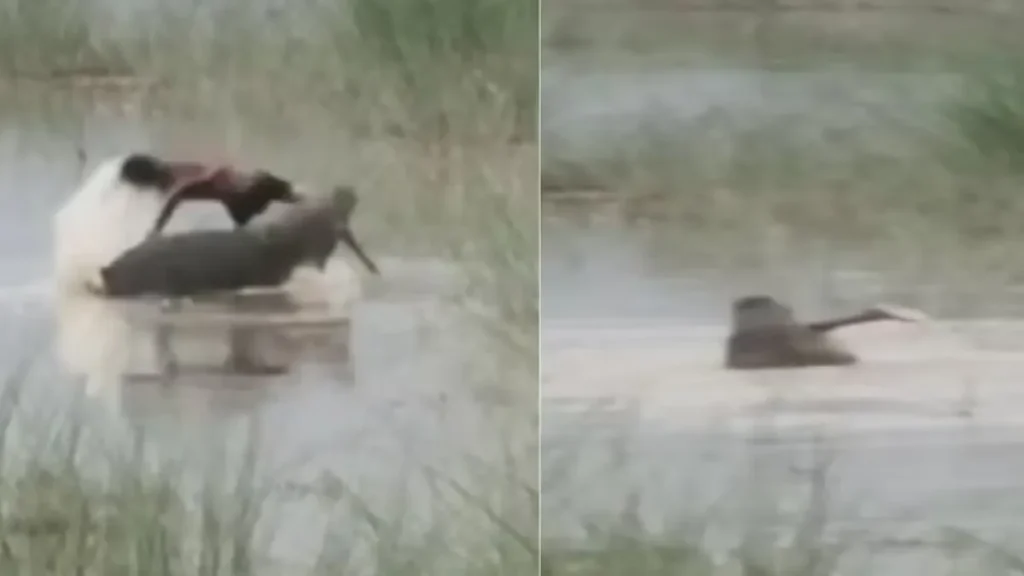
A tragic Crocodile attack in Uttar Pradesh’s Bahraich district has left an entire community in shock after a 12-year-old boy was reportedly dragged into the Ghaghara River and killed while washing himself near the riverbank. The incident, which occurred in Tikuri village under the Boundi police station area, has sparked renewed concerns about increasing human-wildlife conflict along the river.
A video related to the incident has since circulated widely on social media, drawing attention to the dangers faced by residents living near crocodile-inhabited waterways.
Boy Was Washing After Farm Work When the Attack Happened
According to local officials and reports, the victim, identified as Sunil Singh, had accompanied his family to work in nearby agricultural fields. After finishing the day’s work, the sixth-grade student went to the edge of the Ghaghara River to wash the dirt and dust from his hands and feet.
While standing in the shallow water, a crocodile allegedly emerged without warning, grabbed the boy by his leg, and pulled him into the deeper section of the river. The sudden attack left little time for anyone nearby to intervene.
Villagers Rushed to Help but Could Not Save Him
People working in nearby fields reportedly heard the boy’s cries for help and immediately rushed toward the river. By the time they reached the spot, however, he had already disappeared beneath the water.
Witnesses claimed they later saw a crocodile near the area where the boy had vanished, intensifying fears that the animal had attacked him. The incident created panic among villagers, many of whom rely on the river for their daily activities.
Five-Hour Search Ends in Recovery of the Body
Soon after the attack, local residents organized a large search operation using boats and fishing nets. The search continued for nearly five hours before the boy’s body was recovered from the river.
Forest officials later stated that parts of the victim’s body had been severely damaged during the attack. According to officials, injuries were found on the right leg and lower back, consistent with a crocodile attack.
The recovery of the body left the grieving family devastated as relatives and villagers gathered at the scene.
Officials Confirm Attack and Viral Video
Authorities have confirmed that the fatal attack did take place. Station House Officer T.N. Maurya stated that the crocodile attack was genuine and also confirmed that the video circulating online is authentic.
Forest department officials visited the location following the incident to assist with the investigation and assess the circumstances surrounding the attack.
Officials have not indicated whether the crocodile involved has been captured or relocated.
Compensation Announced for the Victim’s Family
Deputy Divisional Magistrate (SDM) Prakash Singh said the district administration has been informed about the incident and that financial assistance will be provided under the state’s compensation policy for wildlife-related fatalities.
According to officials, the victim’s family will receive ₹4 lakh as compensation.
The administration has also assured residents that the incident will be reviewed in coordination with the forest department.
Residents Raise Concerns Over Growing Crocodile Threat
Following the tragedy, villagers accused authorities of failing to address the growing presence of crocodiles in the Ghaghara River. Local residents said attacks on livestock have occurred in the past and claimed they had repeatedly requested stronger safety measures from the authorities.
Many families living along the river depend on it for washing, farming, and other daily needs, making encounters with wildlife difficult to avoid. Residents argue that warning systems, awareness campaigns, and protective measures are needed to reduce the risk of future attacks.
Also Read: Asad Encounter: Main Accused in Ghaziabad Teen Murder Case Killed During Police Operation
Human-Wildlife Conflict Remains a Serious Challenge
The latest Crocodile attack has once again highlighted the ongoing challenge of balancing wildlife conservation with public safety. Rivers such as the Ghaghara provide important habitat for crocodiles, but they are also essential to the livelihoods of nearby communities.
Wildlife experts have long emphasized that reducing human-crocodile conflict requires a combination of habitat management, public awareness, clearly marked danger zones, and coordinated action by local administrations and forest departments.
As authorities continue their inquiry, the incident serves as a painful reminder of the risks faced by people who depend on rivers where crocodiles are known to live. For residents of Bahraich and other riverbank communities, the tragedy has renewed calls for stronger safety measures to help prevent similar incidents in the future.