
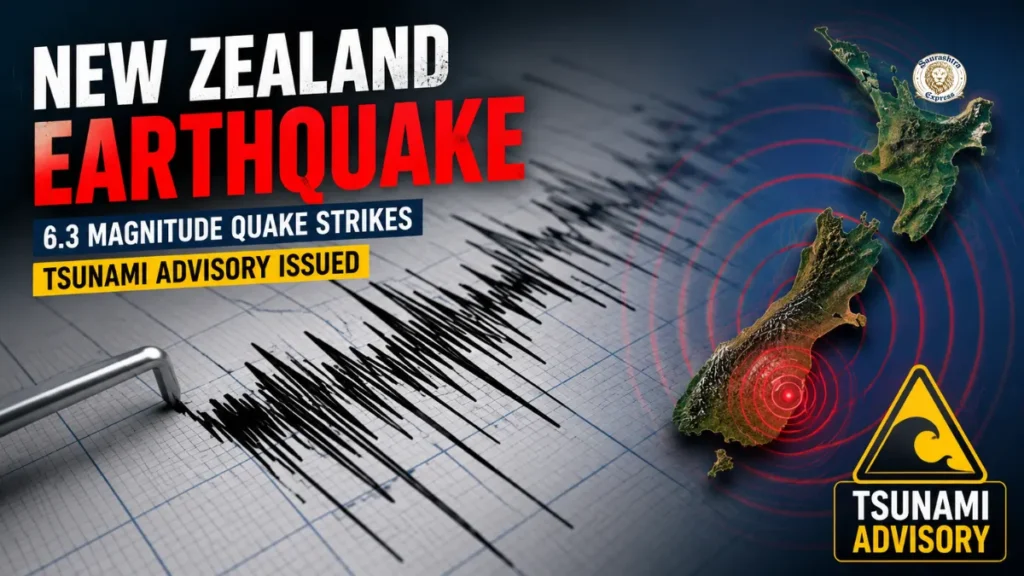
A New Zealand Earthquake measuring 6.3 in magnitude struck the country’s South Island on Thursday, prompting authorities to issue a tsunami advisory for parts of the coastline. The strong tremor was felt across the region, although there were no immediate reports of widespread damage or casualties.
The earthquake occurred near the scenic Fiordland region, one of New Zealand’s most well-known natural destinations. Officials quickly began assessing the situation while emergency agencies urged residents in affected coastal areas to stay alert and follow official safety instructions.
Earthquake Recorded Near Fiordland Region
According to the United States Geological Survey (USGS) and Germany’s GFZ Centre for Geosciences, the earthquake was recorded at a depth of more than 50 kilometres beneath the surface. While some monitoring agencies measured the event at magnitude 5.9, local authorities reported a stronger reading of 6.3 on the Richter scale.
The epicentre was located about 40 kilometres north of Te Anau, a popular gateway town to Fiordland National Park. The region is known for its dramatic landscapes, fjords, and attracts thousands of tourists each year.
Residents reported feeling strong shaking, but authorities have not confirmed any significant structural damage in the immediate aftermath of the quake.
Tsunami Advisory Issued for Coastal Areas
Following the earthquake, emergency management officials issued a tsunami advisory for parts of New Zealand’s coastline as a precautionary measure.
Authorities advised people in low-lying coastal communities to remain vigilant and stay away from beaches, harbours, and estuaries until further updates were released. Tsunami advisories are commonly issued after powerful offshore earthquakes to assess the possibility of dangerous sea-level changes, even if a major tsunami does not ultimately develop.
Officials continued monitoring sea conditions and seismic activity while urging the public to rely on official alerts rather than rumours circulating on social media.
Gujarat’s Kutch District Experiences Two Tremors
On the same day, residents of Kutch district in Gujarat, India, experienced two mild earthquakes within just three minutes.
According to the Institute of Seismological Research (ISR) in Gandhinagar, the first tremor, measuring 3.6 in magnitude, occurred at 2:20 p.m. IST. Its epicentre was located about 32 kilometres northeast of Khavda.
A second earthquake measuring 3.2 struck at 2:23 p.m., with its epicentre approximately 32 kilometres northwest of Dholavira.
The two events were separate from the New Zealand earthquake and occurred in a different tectonic setting. There is no indication that the seismic activity in Gujarat was connected to the earthquake near New Zealand.
No Reports of Casualties or Major Damage
Officials in Gujarat confirmed that there were no immediate reports of injuries, deaths, or significant property damage following the tremors in Kutch.
Local authorities continued monitoring the situation, while disaster management teams remained on alert as a precaution. Residents were advised to remain calm and report any structural damage if observed.
Similarly, in New Zealand, emergency services continued assessing the impact of the stronger earthquake, with no confirmed reports of fatalities or widespread destruction in the hours following the event.
Also read: Balochistan Independence Claim Sparks Debate as Viral Statement Circulates Online
Why New Zealand Frequently Experiences Earthquakes
New Zealand is among the world’s most earthquake-prone countries because it sits along the boundary of the Pacific Plate and the Australian Plate. The movement of these tectonic plates regularly produces earthquakes of varying intensity across both the North and South Islands.
Fiordland, in particular, has experienced several significant earthquakes over the years due to its active geological setting. As a result, New Zealand maintains one of the world’s most advanced earthquake monitoring and emergency response systems.
Authorities Continue Monitoring the Situation
Emergency agencies in New Zealand are continuing to monitor aftershocks and ocean conditions following the New Zealand Earthquake. Residents have been advised to stay informed through official government updates and follow any evacuation or safety instructions if conditions change.
Meanwhile, authorities in Gujarat have confirmed that the two minor earthquakes in Kutch caused no reported damage, and routine monitoring of seismic activity in the region is continuing.