
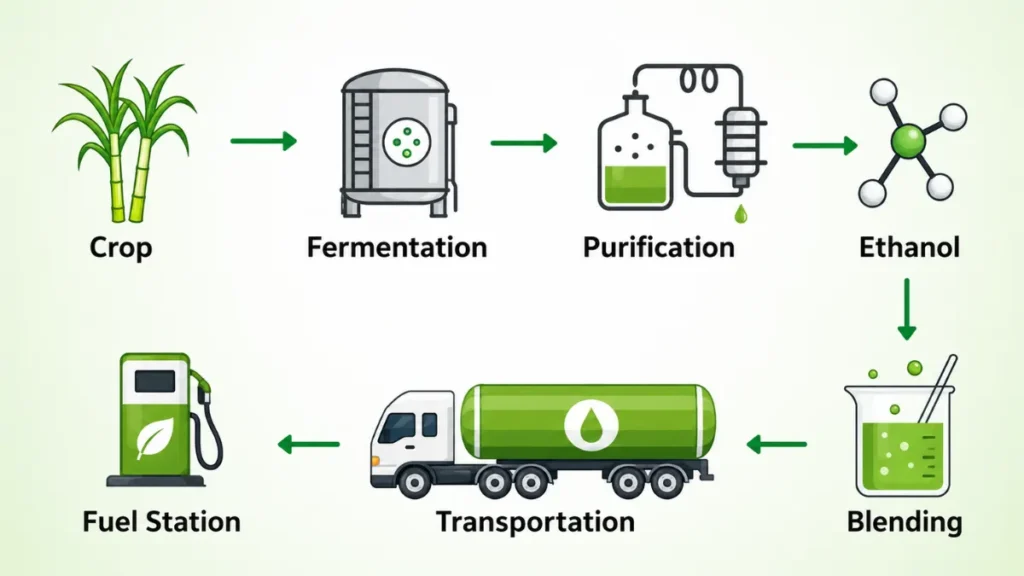
Ethanol Blending has once again become the subject of public debate in India, particularly among vehicle owners concerned about the impact of E20 fuel on engine performance and maintenance costs. Responding to these concerns, the Central Government has stated that the country’s ethanol blending programme is based on years of scientific research, extensive testing, and international best practices rather than a sudden policy decision.
Speaking at an industry experts’ press conference in New Delhi on Saturday, government representatives said the transition to higher ethanol content in petrol has been carefully planned and implemented over several years. Officials emphasized that the programme has undergone detailed evaluation by leading automotive and research institutions before being introduced on a large scale.
Government Says Ethanol Blending Is a Gradual, Research-Based Process
Addressing the media, industry expert Vartika Shukla explained that India’s ethanol blending journey began modestly. During 2013 and 2014, petrol sold in the country contained only around 1.5% ethanol.
Since then, the government has steadily expanded the programme under a phased roadmap. Today, India has achieved the supply of E20 fuel, which contains 20% ethanol and 80% petrol. According to the government, the national target for 20% ethanol blending was achieved by December 2025—five years ahead of the original schedule.
Officials said the programme was developed through consultations with multiple stakeholders and was supported by scientific evidence at every stage.
Why Is E20 Fuel Facing Opposition?
Despite the government’s confidence in the programme, some vehicle owners continue to express concerns about the use of E20 fuel, especially those driving petrol vehicles manufactured before 2023.
Many motorists claim that the higher ethanol content has reduced fuel efficiency, increased maintenance expenses, and may accelerate wear on certain engine components. These concerns have led to wider discussions about whether older vehicles are fully compatible with E20 petrol.
The government, however, maintains that while ethanol-blended fuel may result in a slight reduction in mileage because ethanol contains less energy than conventional petrol, the overall impact on vehicle performance is limited. Officials argue that engine responsiveness and pickup can improve when engines are designed or calibrated for ethanol-blended fuel.
Extensive Testing Conducted by Leading Automotive Agencies
According to Vartika Shukla, the Ethanol Blending Programme (EBP) was formally presented for structured discussions with industry stakeholders in 2018. The initiative was developed through consultations involving automobile manufacturers, fuel companies, policymakers, and technical experts.
She said the programme is backed by scientific studies and has received support from the automotive industry. Leading organisations, including the Automotive Research Association of India (ARAI) and the Society of Indian Automobile Manufacturers (SIAM), have conducted extensive testing to evaluate the performance and safety of ethanol-blended fuel under Indian conditions.
The government believes these assessments provide confidence that the programme can be implemented safely while supporting the country’s long-term energy strategy.
A Step Towards Cleaner Transportation
Officials also highlighted the environmental benefits of increasing Ethanol Blending in petrol. Ethanol is produced from renewable agricultural feedstocks, making it an alternative to conventional fossil fuels.
By replacing a portion of petrol with ethanol, the government aims to reduce dependence on imported crude oil while lowering carbon emissions from the transport sector. The initiative is also expected to support domestic agriculture by creating additional demand for crops used in ethanol production.
Government representatives described ethanol blending as a globally accepted practice that aligns with international efforts to make transportation more sustainable. They said many countries already use ethanol-blended fuels as part of their clean energy strategies.
Conclusion
As India continues expanding the use of E20 fuel, discussions between policymakers, automobile manufacturers, and consumers are expected to continue. While some vehicle owners remain cautious about its long-term effects on older vehicles, the government maintains that the programme has been introduced only after extensive scientific validation and industry consultation.
With the country having reached its ethanol blending target ahead of schedule, officials say the focus will now remain on ensuring smooth implementation, improving public awareness, and supporting India’s broader goals of energy security, lower emissions, and cleaner mobility.