
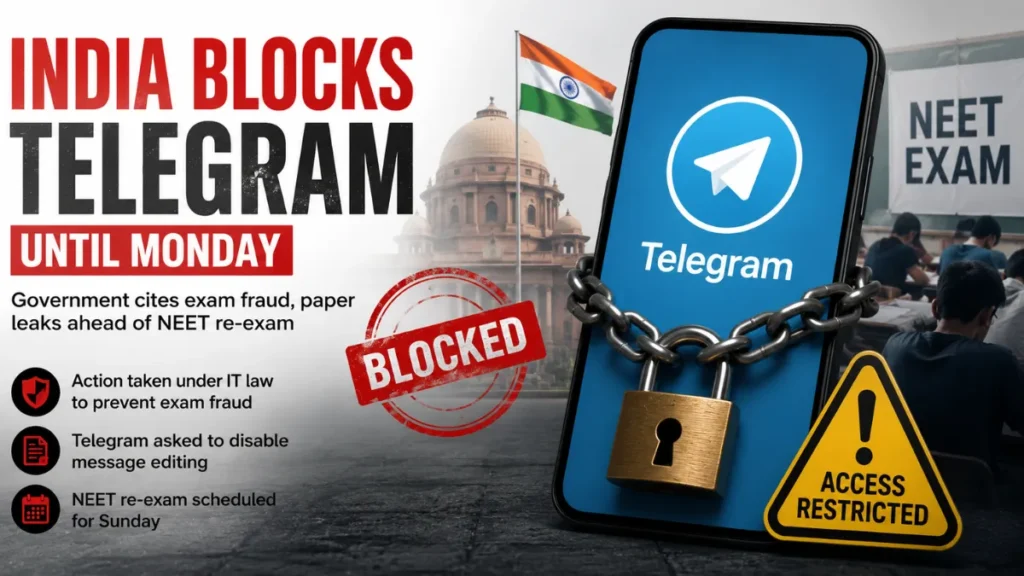
Government Takes Emergency Action Over Alleged Misuse of Messaging Platform
The Indian government has temporarily restricted access to Telegram until Monday, citing concerns that the messaging platform has been used to facilitate cheating and distribute leaked examination materials ahead of a major national entrance test.
Authorities also directed the platform to disable the ability to edit previously published messages during the restriction period. Officials said the move was intended to prevent the alteration or circulation of content linked to organized exam fraud networks.
The decision comes just days before the rescheduled National Eligibility-cum-Entrance Test (NEET), one of India’s most important entrance examinations for students seeking admission to medical colleges. The new exam is scheduled to take place on Sunday following the cancellation of the original test amid allegations of widespread paper leaks.
Exam Leak Controversy Sparks National Debate
The NEET examination has been at the center of a growing controversy after investigators discovered that exam questions had allegedly been leaked before candidates sat for the test. The revelations prompted authorities to cancel the examination and announce a fresh date, affecting hundreds of thousands of students across the country.
The incident has intensified public scrutiny of examination security and raised concerns about the integrity of competitive testing systems. For many students, the cancellation created uncertainty after months of preparation for one of the country’s most competitive academic assessments.
Officials have since pledged stronger safeguards to ensure the fairness of the re-examination and prevent further breaches.
Legal Powers Used to Enforce Temporary Ban
The restriction on Telegram was reportedly issued under provisions of India’s information technology laws that allow the government to block access to online platforms under specific circumstances. Authorities argued that the action was necessary to protect the integrity of the examination process and prevent criminal networks from exploiting digital communication channels.
In a statement, the National Testing Agency (NTA), which conducts the examination, said the temporary measures were taken in response to the alleged coordinated use of Telegram by groups involved in exam-related fraud ahead of the NEET 2026 re-test.
Government officials described the move as a last-resort measure, stating that previous attempts to remove problematic content had not delivered the desired results. They also acknowledged that the restriction would inconvenience a large number of users but maintained that protecting the examination process was a priority.
Student Frustration Fuels Online Protest Movement
The examination controversy has also triggered widespread student dissatisfaction and public demonstrations. In the aftermath of the cancellation, a youth-led satirical protest campaign known as the Cockroach Janta Party gained significant attention on social media platforms.
The movement used humor and satire to express frustration over the handling of the examination crisis and called for accountability from education authorities. Its rapid rise highlighted the growing role of digital platforms in shaping public discourse around educational issues in India.
The protests reflected broader concerns among students and parents regarding transparency, fairness, and trust in high-stakes entrance examinations.
Telegram Pushes Back Against Restrictions
Telegram, which has become one of the most widely downloaded messaging applications in India, criticized the government’s decision. India represents one of the platform’s largest user bases, making the temporary restriction particularly significant.
Telegram founder Pavel Durov argued that blocking the service would not eliminate the underlying problem of exam leaks. According to him, individuals involved in distributing unauthorized materials could simply migrate to alternative communication platforms.
He also expressed concern that the measure would primarily affect ordinary users who rely on Telegram for personal, educational, and professional communication rather than those responsible for the alleged misconduct.
Also read: Order of Canada: Meaning, History, Levels, and Importance
Balancing Security and Digital Rights
The temporary block has reignited debate over how governments should respond to online misuse while protecting access to digital communication tools. Supporters of the move argue that extraordinary circumstances may require strong intervention when national examinations are at risk. Critics, however, contend that broad restrictions can disrupt legitimate users and raise questions about digital freedoms.
As students prepare for the rescheduled NEET examination, attention will remain focused on whether the enhanced security measures succeed in preventing further leaks. The outcome could influence future discussions about exam security, online platforms, and the responsibilities of technology companies in combating misuse.
For now, the temporary restriction on Telegram underscores the challenges authorities face in balancing public interest, educational integrity, and access to digital communication services in an increasingly connected society.