
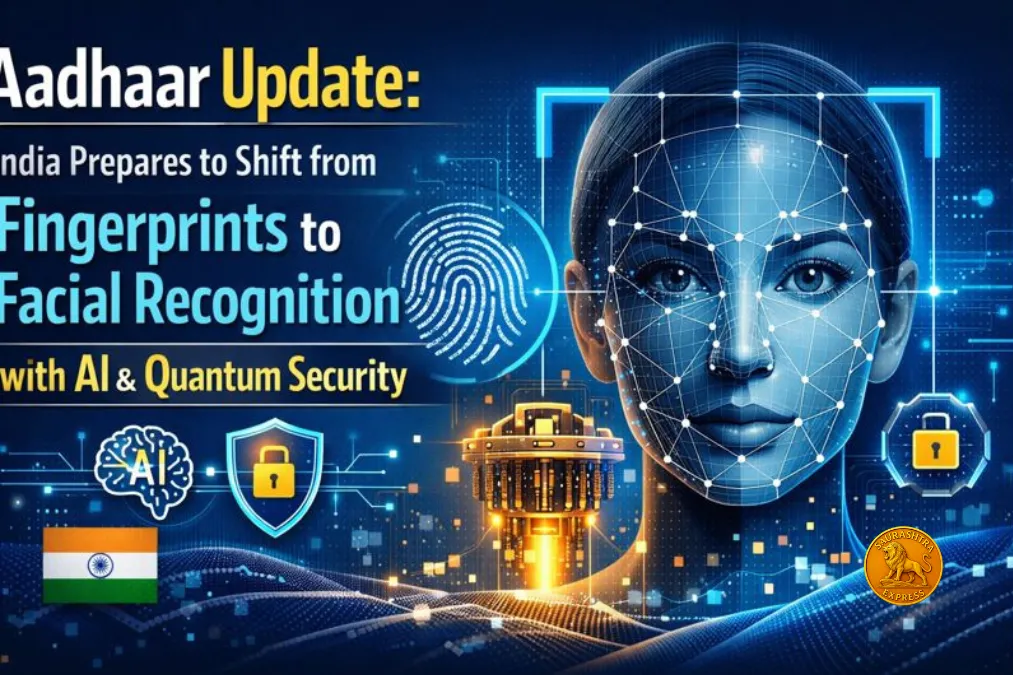
Aadhaar Update: India is preparing for a major technological transformation of its Aadhaar system as the government plans to move away from fingerprint-based verification and adopt facial recognition as the primary method of identity authentication. According to senior officials, the upcoming Aadhaar update will focus on speed, security, and fraud prevention by integrating advanced technologies such as artificial intelligence (AI), cloud computing, blockchain, and quantum computing.
The roadmap for this transformation has been outlined in a strategic document titled “Aadhaar Vision 2032”, which has now been finalised at the conceptual level. The document sets out a long-term plan to modernise the country’s digital identity infrastructure and prepare it for future technological challenges while ensuring user convenience and data security.
Facial Recognition to Replace Fingerprints
One of the most significant changes proposed under the Aadhaar update is the gradual replacement of fingerprint-based authentication with facial recognition. Currently, Aadhaar authentication relies heavily on fingerprints and iris scans. However, worn-out fingerprints—especially among manual workers and elderly citizens—have long been a challenge, often leading to authentication failures.
Facial recognition is expected to address these issues by offering a more reliable and accessible alternative. At present, India conducts around 90 million Aadhaar authentications every day, out of which approximately 10 million are already done using face authentication. The government’s long-term target is ambitious: 1 billion facial recognition-based authentications every month.
This transition is expected to significantly reduce dependency on repeated biometric submissions, making Aadhaar verification smoother for citizens across services such as banking, welfare schemes, telecom, and travel.
AI-Driven Continuous Updates
Under the new system, AI will play a central role in keeping facial data updated. Instead of requiring users to frequently visit Aadhaar centres for biometric updates, AI-enabled systems will periodically refresh facial recognition data to ensure accuracy. This means fewer interruptions for users and a lower administrative burden for the system.
Officials believe this AI-driven approach will make Aadhaar authentication more adaptive and future-ready, especially as facial features naturally change over time due to age or health conditions.
Free Biometric Updates for Children Continue
As part of ongoing Aadhaar update efforts, the government has already completed biometric updates for over 50 million children and adolescents by December. These updates are crucial as biometric details collected at an early age tend to change significantly during growth.
To encourage wider participation, the government has announced that biometric updates for children and teenagers will remain free of cost until September 2026. This move aims to ensure data accuracy while reducing financial barriers for families.
Stronger Security with Quantum and Blockchain Technologies
Security is a core focus of the Aadhaar Vision 2032 plan. With cyber threats becoming increasingly sophisticated, the government plans to strengthen Aadhaar’s security framework using quantum computing and blockchain technology.
Quantum-resistant encryption is expected to protect Aadhaar data from future cyber risks, including attacks that could potentially bypass current encryption standards. Blockchain, on the other hand, will help ensure data integrity and traceability, reducing the risk of tampering or unauthorised access.
Officials have emphasised that these measures will help keep Aadhaar fraud-free while maintaining public trust in the system.
New Technical Framework and Contracts
A specialised committee has been working on designing the next-generation technical architecture for Aadhaar. The committee’s draft framework is expected to be finalised next month and submitted to the Unique Identification Authority of India (UIDAI) by March.
Based on this framework, a new technical infrastructure will be developed for the next five years. The current technology contract for Aadhaar is set to expire in 2027, and a new long-term contract covering operations until 2032 will be awarded.
Expert Committee Behind Aadhaar Vision 2032
The Aadhaar Vision 2032 document was prepared by a high-level committee formed in October last year under the leadership of UIDAI Chairman Neelkanth Mishra. The committee includes leading experts from India and abroad, reflecting the global scale and complexity of the project.
Members of the committee include:
- Vivek Raghavan, Co-founder of Sarvam AI
- Dheeraj Pandey, Founder of Nutanix
- Dr. P. Purnachandran, Amrita University
- Prof. Anil Jain, Michigan State University
- Mayank Vats, IIT Jodhpur
Their combined expertise in AI, cybersecurity, biometrics, and large-scale digital systems has played a crucial role in shaping the future Aadhaar update strategy.
A Future-Ready Digital Identity System
According to Aadhaar CEO Bhuvnesh Kumar, while the roadmap is formally titled Vision 2032, the planning goes beyond that timeline. Rapid advancements in AI and quantum computing are already reshaping the global technology landscape, and Aadhaar must evolve to remain resilient and relevant.
The upcoming Aadhaar update represents one of the most significant upgrades since the system’s launch. By prioritising facial recognition, AI automation, and next-generation security technologies, India aims to build a faster, safer, and more inclusive digital identity ecosystem for over a billion citizens.
As implementation begins in the coming years, Aadhaar is set to become not just a national identity platform, but a benchmark for digital identity systems worldwide.