
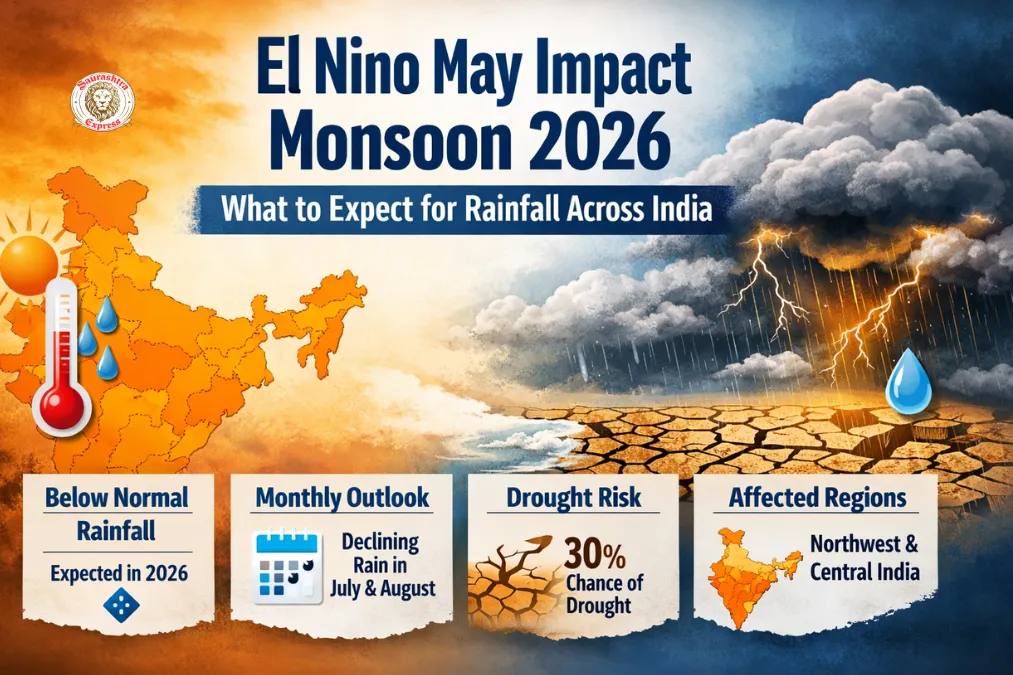
India’s southwest monsoon in 2026 could face significant challenges due to the looming influence of El Nino, according to a recent forecast by private weather agency Skymet Weather. The agency predicts that overall rainfall may fall below normal levels this year, raising concerns about agricultural productivity and water availability in several regions.
Skymet Weather’s Managing Director, Jatin Singh, explained that the La Niña conditions, which have influenced the global climate for the past 18 months, are now waning. The Pacific Ocean is gradually moving toward an ENSO-neutral (El Niño–Southern Oscillation-neutral) phase. However, the agency warns that El Nino may develop during the early stages of the monsoon and strengthen later in the season, potentially weakening the monsoon and causing irregular rainfall distribution across the country.
Monthly Rainfall Forecast 2026
The expected rainfall from June to September is summarized in the table below:
| Month | Rainfall (% of LPA) | Outlook |
|---|---|---|
| June | 101% | Normal start to monsoon, good initial rains |
| July | 95% | Slight reduction in rainfall |
| August | 92% | Further decrease, irregular rainfall likely |
| September | 89% | Monsoon weakest, significant drop expected |
State-wise Impact
The below table highlights regions likely to be affected the most:
| Region | Expected Rainfall | Key Observations |
|---|---|---|
| Punjab, Haryana, Rajasthan | Below normal | August-September likely to see significant deficit |
| Central India | Slightly below normal | Rainfall may be uneven, drought risk possible |
| Eastern & North-Eastern India | Near normal | Better rainfall expected compared to rest of India |
Key Forecast Highlights
- Total Rainfall: 94% of LPA (~868.6 mm)
- Drought Risk: 30% probability of drought conditions
- Normal Rainfall Probability: Only 20% chance
- Indian Ocean Dipole (IOD): Expected to remain neutral; may support monsoon start but cannot fully offset El Nino impact
Implications for Agriculture and Water Resources
A weaker monsoon could impact crop yields, especially in rain-dependent regions, and strain water resources. Farmers and policymakers are advised to monitor updates and prepare for potential water shortages in affected areas.
Experts note that El Nino typically brings uneven rainfall. Some areas may still receive adequate precipitation, while others may experience prolonged dry spells, emphasizing the importance of adaptive planning in agriculture, irrigation, and urban water management.
Also Read: Ashok Kharat Case: SIT Receives Over 50 Complaints in Five Days as Probe Intensifies in Nashik
Conclusion
Monsoon 2026 is expected to show El Nino-induced variability, with a good start in June but a declining trend through August and September. Central and northwestern India should prepare for below-average rainfall, while eastern and northeastern regions may fare better. Continuous monitoring of climate updates will be crucial to mitigate impacts on crops, water resources, and livelihoods.