
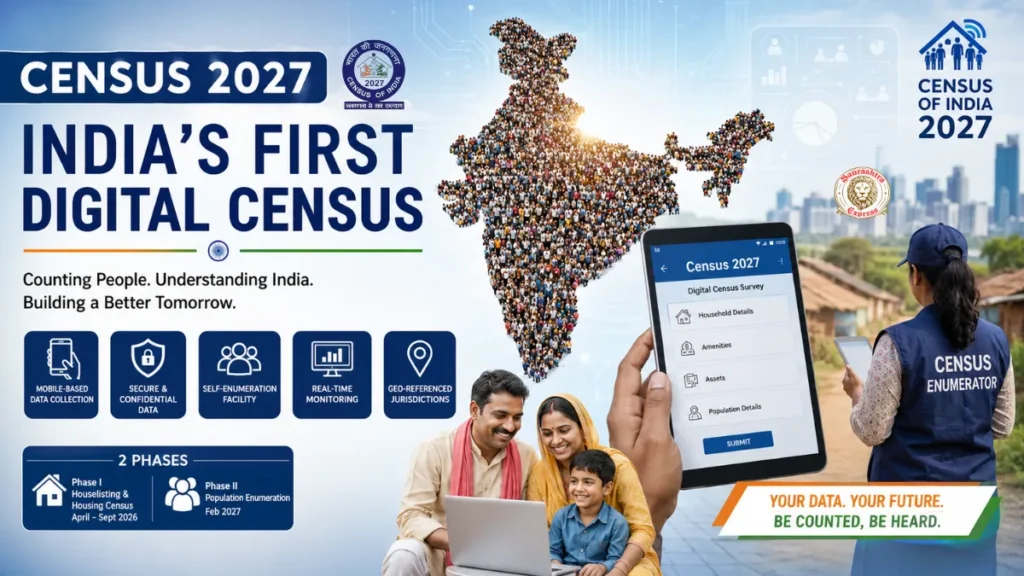
India Prepares for Its First Fully Digital Census
Digital census Registration: India is preparing for one of the largest administrative exercises ever attempted anywhere in the world. Census 2027, expected to cover more than a billion people across cities, villages, remote settlements, and difficult terrains, will become the country’s first fully digital census operation. The nationwide exercise is being designed not only as a population count, but also as a technology-driven governance project aimed at improving policymaking, welfare delivery, infrastructure planning, and demographic analysis.
The upcoming census marks a historic shift in the way India collects and manages population data. For the first time, enumerators will use mobile-based digital tools instead of relying entirely on paper forms. Citizens will also get an opportunity to submit information online through a self-enumeration system before official field visits begin.
The government has described Census 2027 as a modernized, secure, and highly coordinated exercise that combines technology, administrative planning, and data protection measures. Another major feature of the exercise will be caste enumeration, which has been approved by the Cabinet Committee on Political Affairs.
Backed by an approved financial outlay of ₹11,718.24 crore, the census is expected to involve millions of field workers, thousands of training sessions, advanced digital infrastructure, and strict data privacy safeguards.
Why Census Data Matters for India
A census is much more than a headcount. It provides governments with detailed information about how people live, where they live, what resources they have access to, and how populations are changing over time.
Population data collected through the census influences a wide range of decisions, including:
- Distribution of public welfare schemes
- Infrastructure development
- Urban planning
- Rural development
- Housing policies
- Water and electricity planning
- Health and education programs
- Electoral representation
- Economic policy formulation
Because the census covers every household in the country, it remains one of the most reliable and comprehensive sources of demographic information available to policymakers, researchers, and public institutions.
Officials say the digital transformation planned for Census 2027 is intended to improve both the speed and quality of this data collection process.
A Look Back at the History of Census in India
India’s census tradition goes back centuries. Historical references to population and administrative surveys can be found in ancient texts such as Kautilya’s Arthashastra and later in Mughal-era records like Abul Fazl’s Ain-e-Akbari.
However, the modern census system began during British rule. The first large-scale population count was conducted between 1865 and 1872, although it was not carried out simultaneously across the country. India’s first synchronized national census took place in 1881.
Since then, census exercises have generally been conducted every ten years. Over time, the process expanded in scale and sophistication, gradually incorporating more detailed questions on social, economic, and housing conditions.
The census scheduled for 2021 could not be conducted because of the COVID-19 pandemic. As a result, Census 2027 now becomes the next major national enumeration exercise and the 16th census in India’s history since the beginning of modern census operations.
It will also be the eighth census conducted after Independence.
What Makes Census 2027 Different
Census 2027 represents a major technological transition for India’s population data systems. Earlier census operations depended heavily on physical paperwork, manual compilation, and lengthy processing timelines. In many cases, it took years for complete datasets to become publicly available.
The 2027 exercise seeks to reduce those delays through digital data collection and centralized monitoring systems.
Key innovations planned for the census include:
- Mobile-based enumeration
- Real-time progress monitoring
- Self-enumeration facility for citizens
- Geo-referenced mapping systems
- Digital houselisting
- End-to-end encrypted data handling
- Faster processing and dissemination of results
Officials believe these measures could significantly reduce errors, duplication, and delays in data handling.
Caste Enumeration to Be Included
One of the most discussed features of Census 2027 is the decision to include caste enumeration.
Until the 2011 Census, official census exercises collected caste data primarily for Scheduled Castes (SCs) and Scheduled Tribes (STs). The new decision expands the scope of caste-related data collection.
The Cabinet Committee on Political Affairs approved the inclusion of caste enumeration during a meeting held on April 30, 2025.
The move is expected to have important implications for social justice policies, welfare planning, reservation-related discussions, and socio-economic assessments.
Supporters of caste enumeration argue that updated caste data is necessary for designing targeted development programs and understanding inequalities across communities. Critics, however, have raised concerns about the administrative complexity and political implications of such an exercise.
Despite the debate, the government has confirmed that caste-related information will be collected during the Population Enumeration phase of the census.
How the Digital census Registration System Will Work
A major part of the modernization effort is the Digital census Registration system, which introduces online and mobile-based participation options.
Under the new framework, eligible residents will be able to submit household information digitally before official field visits begin.
The self-enumeration facility is expected to reduce paperwork, speed up verification, and improve convenience for urban and digitally connected populations.
According to the plan, citizens using the online system will receive a Self-Enumeration ID after submitting information. Enumerators visiting the household later will verify the details using this ID.
The government says the platform will include:
- Tutorial videos
- FAQs
- Tooltips
- User guides
- Validation checks
- Multi-language support
The Digital census Registration initiative is also intended to reduce operational bottlenecks and improve accuracy through automated checks.
Two-Phase Structure of Census 2027
The census will be conducted in two major phases.
Phase One: Houselisting and Housing Census
The first phase, known as Houselisting and Housing Census (HLO), is scheduled between April and September 2026.
This phase focuses on housing conditions and household-level infrastructure details.
Enumerators will gather information related to:
- Housing quality
- Ownership status
- Water availability
- Cooking fuel
- Internet access
- Toilet facilities
- Household assets
- Number of rooms
- Availability of kitchen and LPG/PNG connections
The government says this stage will also create the framework required for the second phase.
An optional self-enumeration window of 15 days will be available before the beginning of physical house-to-house visits.
Phase Two: Population Enumeration
The second phase, called Population Enumeration (PE), is scheduled for February 2027.
This phase will collect detailed individual-level information, including:
- Demographic details
- Socio-economic data
- Fertility information
- Migration-related information
- Cultural characteristics
- Educational status
- Occupational details
- Caste information
Special timelines have been planned for snow-bound and difficult regions such as Ladakh and certain areas of Jammu and Kashmir, Himachal Pradesh, and Uttarakhand.
What Questions Will Households Be Asked?
The government has already released the questionnaire for the houselisting phase.
The questions cover multiple categories.
Housing Structure
Officials will collect information about:
- Flooring material
- Wall material
- Roof material
- Building condition
- Usage of the census house
Household Information
The census will also gather details such as:
- Number of family members
- Name and gender of household head
- Social category
- Number of married couples
- Number of dwelling rooms
Amenities and Basic Services
Questions will include information on:
- Drinking water access
- Source of lighting
- Toilet availability
- Bathing facility
- Kitchen access
- Cooking fuel
Household Assets
Enumerators will ask whether households possess:
- Television
- Radio
- Internet access
- Laptop or computer
- Mobile phones
- Vehicles such as bicycles, scooters, and cars
The government says this information helps policymakers identify development gaps and understand living conditions across regions.
Census Moment and Reference Date Explained
Every census exercise requires a fixed reference point for counting people. In Census 2027, the official reference date has been set as 00:00 hours on March 1, 2027.
This specific point in time is known as the “Census Moment.”
It helps enumerators determine which individuals should be included in the count.
For snow-bound regions and difficult terrains, a separate reference date of October 1, 2026, has been fixed.
Census Management & Monitoring System (CMMS)
One of the most important digital components of Census 2027 is the Census Management & Monitoring System, commonly referred to as the CMMS portal.
The portal has been developed to monitor and coordinate census operations in near real-time.
Through integrated dashboards, officials at multiple administrative levels will be able to track:
- Enumeration progress
- Performance of field staff
- Geographic coverage
- Operational readiness
- Upload status of field data
The digital monitoring system is expected to improve accountability and reduce delays in field reporting.
Mobile Applications for Enumerators
Enumerators participating in the census will use dedicated mobile applications for data collection.
The Houselisting and Housing Census mobile app has been designed as a secure offline-compatible platform.
Key features include:
- Offline data collection capability
- Secure synchronization
- Direct server upload
- Multi-language support
- Android and iOS compatibility
The government says the application will support 16 regional languages.
Officials believe this multilingual approach is important for ensuring accurate data collection in linguistically diverse regions.
Digital Mapping and Geographic Accuracy
Another major innovation is the use of the Houselisting Block Creator web mapping application.
This system allows charge officers to create digital houselisting blocks using satellite imagery and geographic mapping tools.
The objective is to ensure:
- Complete coverage
- No duplication
- Better field coordination
- Improved geographic precision
Digital mapping could also help reduce administrative confusion in rapidly urbanizing regions where settlement patterns change quickly.
Self-Enumeration Facility: A Citizen-Centric Shift
The self-enumeration facility is one of the most citizen-focused aspects of Census 2027.
Instead of waiting for an enumerator visit, households can voluntarily submit details online during the designated period.
The system will be accessible in multiple Indian languages, including:
- English
- Hindi
- Gujarati
- Bengali
- Tamil
- Telugu
- Marathi
- Malayalam
- Punjabi
- Urdu
- Assamese
- Kannada
- Odia
- Nepali
- Manipuri
- Konkani
The government hopes this feature will improve participation rates, especially among digitally aware urban populations.
At the same time, traditional door-to-door enumeration will continue to ensure inclusion of people without internet access.
Administrative Structure Behind Census Operations
The census exercise relies on a massive administrative network that spans from the Union government to local officials.
At the national level, the Registrar General and Census Commissioner of India oversees operations.
At the state and district levels, implementation involves:
- Chief Secretaries
- Nodal Officers
- District Magistrates
- Municipal Commissioners
- Charge Officers
- Enumerators
- Supervisors
Teachers, government employees, and local body officials are expected to form a major part of the field workforce.
Legal Framework Governing the Census
Census operations in India are governed by the Census Act, 1948, along with the Census Rules of 1990.
The law provides the legal basis for nationwide data collection and ensures standardization across states and union territories.
Importantly, the law also contains strict confidentiality protections.
Under Section 15 of the Census Act:
- Personal census data cannot be publicly disclosed
- Individual responses cannot be used as court evidence
- Information cannot be shared with outside institutions
- Data remains protected from disclosure under the RTI Act
These safeguards are intended to build public trust and encourage honest participation.
Data Security Measures and Privacy Protections
Because Census 2027 will rely heavily on digital systems, cybersecurity and privacy protection have become central concerns.
Officials say the census will operate under a multi-layered security framework.
Measures include:
- End-to-end encryption
- Secure transmission systems
- Certified data centres
- Continuous monitoring
- Security audits
- ISO/IEC 27001:2022 compliance
The data centres used for census operations have also been designated as Critical Information Infrastructure (CII), which provides an additional layer of protection.
The government says these safeguards are essential to prevent unauthorized access or misuse of sensitive information.
Massive Human Resource Mobilization
Conducting a census in a country as large and diverse as India requires extraordinary manpower.
For Census 2027, approximately:
- 31 lakh enumerators and supervisors
- More than 1 lakh census functionaries
- Around 18,600 technical personnel
are expected to participate in the exercise.
Authorities are conducting more than 80,000 training batches to prepare field workers for both census phases.
Training includes:
- Digital device handling
- Data entry procedures
- Verification protocols
- Privacy compliance
- Field coordination methods
Officials say the structured training process is crucial for maintaining data quality and consistency nationwide.
Employment Generation Through Census Operations
Apart from its administrative significance, Census 2027 is also expected to generate temporary employment opportunities.
Government estimates suggest that around 1.02 crore man-days of employment may be created through technical and field-level operations.
This includes work related to:
- Technology support
- Field coordination
- Data management
- Training
- Monitoring
- Logistics
The scale of the operation makes it one of the largest peacetime administrative mobilizations in the country.
Expansion of Administrative Units Since Census 2011
India’s administrative landscape has changed significantly since the last completed census in 2011.
The number of districts, towns, and sub-districts has increased substantially.
Compared with Census 2011:
- Districts have risen from 640 to 784
- Sub-districts increased from 5,990 to 7,092
- Statutory towns expanded from 4,041 to 5,128
- Census towns grew from 3,892 to 4,580
These changes reflect India’s rapid urbanization and administrative restructuring over the past decade.
Why Faster Census Data Matters
One of the longstanding criticisms of traditional census systems globally has been the long delay between data collection and public release.
India’s digital approach aims to shorten this gap significantly.
Faster availability of census data could help governments:
- Respond more quickly to demographic changes
- Improve welfare targeting
- Plan infrastructure more effectively
- Update development indicators
- Strengthen local governance systems
Officials also say customized visualization tools may be introduced to improve accessibility of census findings.
Challenges Ahead for Census 2027
Despite the technological improvements, the census exercise still faces major challenges.
These include:
Digital Divide
Not all households have internet access or digital literacy. Rural and economically weaker sections may still depend entirely on physical enumeration.
Data Accuracy
Ensuring accurate responses across millions of households remains a massive operational challenge.
Privacy Concerns
As data collection becomes increasingly digital, concerns regarding cybersecurity and surveillance are likely to remain part of the public debate.
Geographic Complexity
India’s terrain includes mountains, forests, deserts, islands, and densely populated urban areas, making complete coverage difficult.
Coordination Across States
Because implementation involves multiple administrative layers, coordination remains critical.
Officials say the extensive preparatory work already underway is intended to address these challenges before full-scale enumeration begins.
Also read: El Nino May Impact Monsoon 2026: What to Expect for Rainfall Across India
Preparatory Measures Already Underway
To prepare for the census, authorities have already completed several administrative steps.
These include:
- Freezing administrative boundaries
- Conducting nationwide pre-tests
- Holding coordination meetings
- Appointing census officers
- Preparing instruction manuals
- Translating materials into multiple languages
A nationwide pre-test covering around 5,000 census blocks was conducted to evaluate methodology and digital systems before large-scale implementation.
Officials say the lessons learned from these tests will help improve operational efficiency during the actual census.
Census and India’s Development Planning
Reliable population data affects nearly every area of governance.
Without updated demographic information, policymakers face difficulties in accurately assessing:
- Population growth
- Migration trends
- Urban expansion
- Educational demand
- Employment patterns
- Healthcare requirements
- Housing shortages
Experts say Census 2027 could play a particularly important role because India has undergone major socio-economic changes since the last completed census cycle.
Urbanization, digital expansion, migration shifts, and changing household structures have altered the country’s demographic landscape significantly.
Updated census data is expected to provide policymakers with a clearer understanding of these transformations.
The Importance of Public Participation
Officials repeatedly emphasize that public participation remains the most important factor in the success of Census 2027.
Even with advanced technology, the accuracy of the census ultimately depends on citizens providing truthful and complete information.
The government is expected to conduct awareness campaigns encouraging households to cooperate with enumerators and use the self-enumeration platform where possible.
Trust will also play a key role, especially in relation to privacy protections and handling of sensitive information.
Also read: Bihar to Launch Aadhar Card Service Centers in Panchayats, Targets 2,000 Centers in First Phase
]A Defining Administrative Exercise for Modern India
Census 2027 is not just another statistical exercise. It represents a major transition in the way India gathers, processes, and uses population data.
The introduction of Digital census Registration, mobile-based data collection, real-time monitoring systems, and online self-enumeration reflects a broader shift toward technology-enabled governance.
At the same time, the exercise remains rooted in traditional census objectives: understanding the population, identifying developmental needs, and supporting informed policymaking.
If implemented successfully, Census 2027 could become one of the most significant digital governance exercises undertaken in India, shaping planning and policy decisions for years to come.